


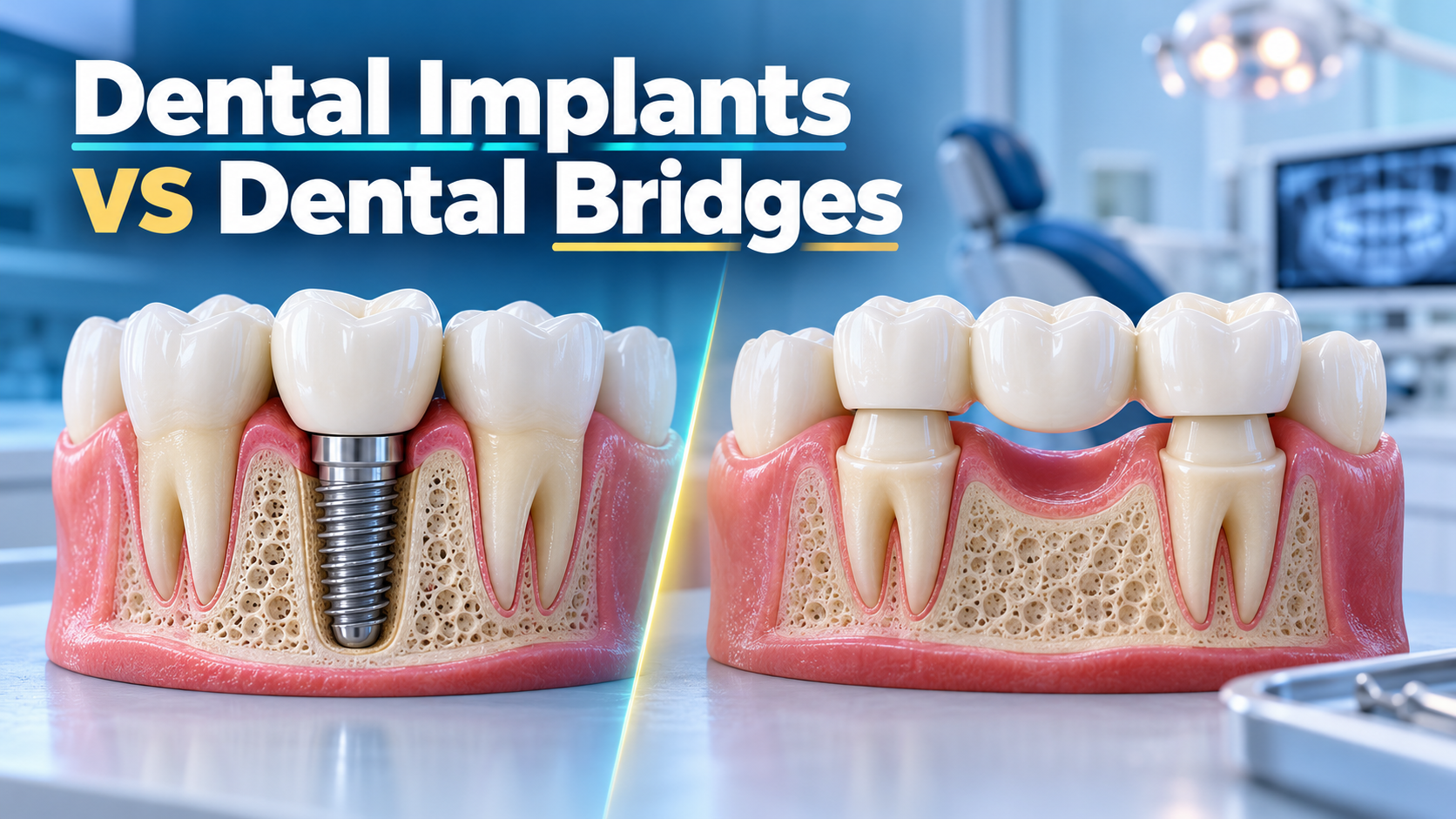
Dental Implants vs Dental Bridges
Dental implants and dental bridges are fixed solutions used to replace missing teeth. A dental implant replaces the missing tooth root and supports a crown, while a traditional dental bridge fills the gap using neighbouring teeth for support.
The right option depends on your oral health, jawbone, surrounding teeth, medical history, budget and treatment preferences. A clinical examination and dental imaging are required before making a decision.
What Is a Dental Implant?
A dental implant is an artificial tooth root, commonly made from titanium, that is surgically placed into the jawbone. After the implant integrates with the bone, it can support a dental crown, bridge or denture.
A single-tooth implant generally consists of:
- An implant placed in the jawbone
- An abutment connecting the implant and crown
- A customised dental crown
Implants can replace a missing tooth without relying on the neighbouring natural teeth for support.
What Is a Dental Bridge?
A dental bridge is a fixed restoration that fills the space created by one or more missing teeth. A traditional bridge usually consists of an artificial tooth supported by crowns placed on the adjacent teeth.
Common types of dental bridges include:
- Traditional dental bridges
- Cantilever bridges
- Resin-bonded bridges
- Implant-supported bridges
The suitable bridge design depends on the location of the missing tooth, bite forces and condition of the supporting teeth.
Dental Implants vs Dental Bridges: Main Differences
Support
A dental implant receives support from the jawbone. A conventional bridge is supported by the natural teeth beside the gap.
Effect on Adjacent Teeth
A single-tooth implant can replace a missing tooth without reshaping healthy neighbouring teeth. A traditional bridge generally requires the supporting teeth to be prepared for crowns.
Treatment Procedure
Dental implant treatment involves a surgical procedure followed by a healing period. A bridge usually does not require implant surgery, although the supporting teeth must be prepared when using a conventional design.
Treatment Time
A dental bridge can often be completed sooner. Implant treatment may take longer because the implant needs time to integrate with the jawbone before the final restoration is fitted.
Bone Considerations
An implant transfers chewing forces to the jawbone and may help maintain bone around the implant site. A conventional bridge fills the visible gap but does not replace the missing tooth root.
Cleaning and Maintenance
Implants require careful brushing and cleaning around the implant crown. Bridges require cleaning under the artificial tooth and around the supporting teeth using suitable floss or interdental aids.
Cost Factors
A dental implant usually has a higher initial cost because it involves surgery, implant components and a crown. Bridge costs depend on the number of teeth involved, materials used and condition of the supporting teeth.
Advantages of Dental Implants
Dental implants may offer the following benefits when a patient is suitable:
- Replace missing teeth without depending on adjacent teeth
- Support a crown, bridge or denture
- Provide stable support for replacement teeth
- Help maintain jawbone at the treated site
- Closely resemble the structure of a natural tooth
- Can provide long-term function with proper care
Implant treatment requires healthy gums, sufficient jawbone and the ability to heal after surgery. Bone grafting may be considered when the available bone is insufficient.
Advantages of Dental Bridges
A dental bridge may offer the following benefits:
- Replaces one or more missing teeth
- Restores appearance and chewing function
- Usually requires less treatment time than an implant
- Does not require implant placement surgery
- Can be suitable when adjacent teeth already need crowns
- Offers different designs for different clinical situations
The health of the supporting teeth and gums is important because they carry the bridge.
Limitations to Consider
Dental Implant Considerations
- Requires a surgical procedure
- Healing may take several months
- Adequate jawbone and healthy gums are required
- Additional procedures may be necessary
- Cost may be higher initially
- Smoking and certain health conditions may affect healing
Dental Bridge Considerations
- Supporting teeth may need to be reshaped
- Adjacent teeth carry additional responsibility
- Cleaning beneath the bridge requires special attention
- Decay or gum problems can affect the supporting teeth
- It does not replace the missing tooth root
Which Option May Be Better for You?
A dental implant may be considered when you have healthy gums, adequate bone and want a replacement that does not rely on neighbouring teeth.
A bridge may be considered when you prefer a quicker fixed solution, cannot undergo implant surgery or have adjacent teeth that already require crowns.
The final choice should be based on:
- Number and location of missing teeth
- Health of neighbouring teeth
- Gum and jawbone condition
- Bite and chewing forces
- General medical health
- Smoking history
- Treatment time
- Budget
- Long-term maintenance needs
Dental Implants and Bridges in Pondicherry
If you are considering a dental implant or bridge in Pondicherry, begin with a complete dental examination. The dentist may assess your gums, remaining teeth, bite and jawbone using dental X-rays or scans.
Ask for a written treatment plan explaining the recommended procedure, alternatives, expected timeline, materials, aftercare and complete cost.
Frequently Asked Questions
Is a dental implant better than a dental bridge?
Neither option is suitable for every patient. An implant avoids relying on neighbouring teeth, while a bridge may offer a faster fixed replacement without implant surgery. Your dentist must assess your mouth before recommending one.
Is dental implant treatment painful?
The procedure is generally performed using local anaesthesia. Temporary soreness or swelling may occur afterward. Your dentist will provide instructions for managing discomfort and supporting healing.
How long do implants and bridges last?
Both can function for many years, but their longevity varies. Oral hygiene, gum health, bite forces, smoking, material quality and regular dental reviews can affect the result.
Which option costs less?
A dental bridge often has a lower initial cost than an implant. However, the complete cost depends on the bridge design, number of teeth, implant requirements, materials and any additional procedures.
Choose the Right Missing-Tooth Replacement
Dental implants and dental bridges can both restore appearance, chewing and confidence after tooth loss. The best solution is the one selected after evaluating your gums, bone, surrounding teeth, medical health and personal priorities.
Book a dental consultation in Pondicherry to compare your treatment options and receive a personalised missing-tooth replacement plan.