


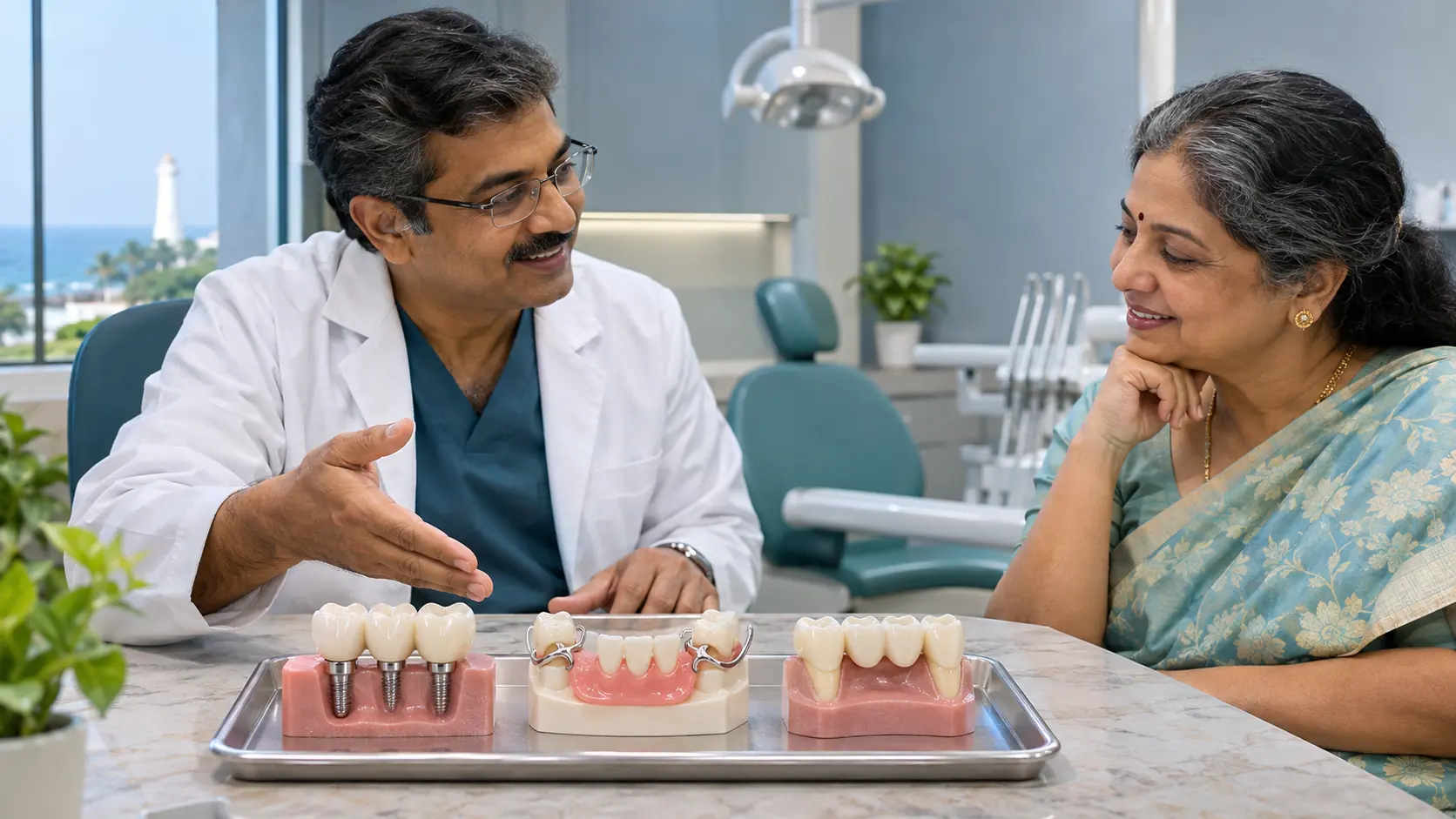
Dental Options for Replacing Multiple Missing Teeth in Pondicherry
Losing several teeth can affect chewing, speech, facial support, confidence and the position of the remaining teeth. The gaps may be next to each other, spread across the mouth or involve most teeth in one jaw.
Dental options for replacing multiple missing teeth in Pondicherry include removable partial dentures, fixed bridges, implant-supported bridges and implant-retained dentures. The most appropriate choice depends on the number and location of missing teeth, the health of the remaining teeth and gums, available jawbone, medical history and budget.
At Smile & Glow Dental Care, treatment planning begins with a complete examination rather than selecting a replacement based only on appearance or cost.
Quick Answer: What Are the Main Options for Multiple Missing Teeth?
Depending on the individual condition, options may include:
- Removable partial dentures
- Cast-metal partial dentures
- Conventional fixed dental bridges
- Implant-supported bridges
- Individual dental implants
- Implant-retained removable dentures
- Fixed full-arch implant restorations
- Complete dentures when all teeth in a jaw are missing
- A combination of treatments for different areas
Not every missing tooth requires a separate implant. In selected cases, strategically placed implants can support a bridge or help stabilise a removable denture.
Why Should Multiple Missing Teeth Be Replaced?
Replacing missing teeth may help restore:
- Chewing ability
- Speech clarity
- Smile appearance
- Support for the lips and cheeks
- Balanced biting forces
- Confidence when eating and speaking
- Stability of the remaining teeth
When a tooth is lost, neighbouring teeth may tilt or move into the space. Opposing teeth may also change position. Bone in the area can gradually reduce because it no longer receives stimulation from a natural tooth root.
Replacement does not automatically prevent every future dental problem. The remaining teeth, gums and replacement teeth still require daily cleaning and professional reviews.
What Happens Before Treatment Is Selected?
A missing-teeth assessment may include:
- Review of dental and medical history
- Examination of the remaining teeth
- Gum and periodontal evaluation
- Assessment of the bite
- Checking available space
- Evaluation of existing dentures, bridges or implants
- Dental X-rays
- Three-dimensional imaging when implant treatment is considered
- Digital scans or impressions
- Jawbone assessment
- Discussion of appearance, function, cost and maintenance
Active tooth decay, gum disease or infection may need treatment before a final replacement is made.
The dentist should also determine whether any remaining teeth can be predictably restored or whether removing a severely damaged tooth would improve the overall treatment plan.
Option 1: Removable Partial Dentures
A removable partial denture replaces one or more missing teeth while using the gums and selected remaining teeth for support.
It can be removed for cleaning and is commonly made using an acrylic base, metal framework or another suitable dental material.
Possible Benefits of Partial Dentures
- Can replace several teeth in different areas
- Usually requires less surgery than implant treatment
- May be completed more quickly than implants
- Can restore appearance and basic chewing function
- May be modified if another tooth is lost in selected cases
- Often has a lower initial cost than fixed implant-supported treatment
Possible Limitations of Partial Dentures
- Must be removed for cleaning
- May initially feel bulky
- Can move slightly during eating or speaking
- May need clasps around natural teeth
- Requires an adjustment period
- Fit can change as gums and bone change
- May need relining, adjustment or replacement
- Does not function exactly like natural teeth
A properly designed partial denture should not be forced into place. Pain, looseness or repeated sores require professional adjustment.
Types of Removable Partial Dentures
Acrylic Partial Denture
An acrylic partial denture may be used as an economical or temporary option. It can replace several teeth and may be easier to modify in selected circumstances.
It may feel thicker than a metal-framework denture and may provide less stability in certain cases.
Cast-Metal Partial Denture
A cast-metal framework can provide improved strength and a thinner design. It usually gains support from selected natural teeth through carefully designed components.
The supporting teeth and gums must be healthy enough to carry the planned forces.
Precision-Attachment Partial Denture
Some partial dentures use attachments rather than visible clasps. Supporting teeth may require crowns or other preparation.
Suitability depends on the remaining teeth, bite, space and cost. Precision attachments also require careful maintenance.
Option 2: Fixed Dental Bridge
A fixed bridge replaces one or more teeth with artificial teeth connected to crowns or retainers supported by neighbouring natural teeth.
Unlike a removable denture, a fixed bridge is cemented in place and can be removed only by a dentist.
Possible Benefits of a Fixed Bridge
- Fixed in the mouth
- Does not need to be removed at night
- Can provide natural-looking tooth replacement
- May restore chewing and speech
- Treatment can sometimes be completed faster than implant treatment
- May be useful when supporting teeth already need crowns
Possible Limitations of a Fixed Bridge
- Supporting teeth may need to be reshaped
- The supporting teeth carry additional load
- Cleaning underneath the bridge requires special aids
- Decay or gum disease can affect the supporting teeth
- Long gaps may not be suitable
- The bridge may need replacement if a supporting tooth fails
- It does not replace the missing tooth roots
The length of the gap, strength of the supporting teeth and bite must be carefully evaluated. A conventional bridge may not be appropriate when too many consecutive teeth are missing.
Option 3: Implant-Supported Bridge
An implant-supported bridge uses dental implants placed in the jawbone to support multiple connected replacement teeth.
For example, several adjacent missing teeth may sometimes be replaced with a bridge supported by fewer implants than the total number of missing teeth. The number and position of implants must be individually planned.
Possible Benefits of an Implant-Supported Bridge
- Does not normally require neighbouring healthy teeth to be reduced
- Fixed in the mouth
- Can provide strong chewing support
- Replaces some missing tooth roots
- May help maintain bone around the implant sites
- Can replace several adjacent teeth
- Often feels more stable than a removable partial denture
Possible Limitations and Risks
- Requires surgery
- Treatment may take several months
- Adequate bone and healthy gums are required
- Bone grafting may be necessary
- Smoking can increase complications
- Implants may fail to integrate with the bone
- Implant components can loosen, wear or fracture
- Gum and bone inflammation can develop around implants
- Long-term professional maintenance is essential
- Initial cost is usually higher than a removable denture
Dental implants cannot decay, but the surrounding gums and bone can become diseased. Daily cleaning remains essential.
Option 4: Individual Dental Implants
Separate implants may be used to replace individual missing teeth when gaps occur in different areas of the mouth.
Each implant generally supports a crown, although treatment design varies. This option may avoid joining multiple teeth together, but it is not necessary or suitable to place one implant for every missing tooth in all cases.
The decision depends on:
- Available bone
- Distance between teeth
- Nerve and sinus position
- Bite forces
- Gum condition
- Implant spacing
- Restorative space
- Cost
- Long-term cleaning access
Option 5: Implant-Retained Removable Denture
An implant-retained denture is removable but attaches to dental implants for improved stability.
This option may be considered when many or all teeth in a jaw are missing and a conventional denture feels loose.
Possible Benefits
- Improved stability compared with a conventional denture
- Better confidence while eating and speaking
- Reduced denture movement
- Easier removal for cleaning than a fixed full-arch restoration
- May require fewer implants than some fixed options
Important Considerations
- The denture must still be removed and cleaned
- Attachments may wear and require replacement
- Implants and gums require daily cleaning
- The denture base may need adjustment or relining
- Surgery and healing are required
- Suitability depends on bone, health and bite
Implant retention improves stability, but the denture may still receive some support from the gums depending on its design.
Option 6: Fixed Full-Arch Implant Restoration
When all or nearly all teeth in one jaw are missing or cannot be retained, a fixed full-arch prosthesis supported by multiple implants may be considered.
The replacement teeth are attached to implants and are not removed by the patient for routine daily cleaning.
This treatment requires detailed planning of:
- Bone volume and quality
- Implant number and position
- Smile and facial support
- Bite relationship
- Cleaning access
- Gum display
- Speech
- Material selection
- Medical suitability
- Long-term maintenance
Terms such as “same-day teeth” may be used in advertising, but immediate fixed teeth are not suitable for every patient. Temporary teeth, healing requirements and final restoration timing depend on implant stability and individual risk.
Option 7: Complete Dentures
When all teeth in an upper or lower jaw are missing, a complete denture can restore appearance and basic function.
Complete dentures rest on the gums and supporting jaw structures. Their stability can vary according to jaw shape, saliva, muscle coordination and fit.
Possible advantages include:
- No implant surgery
- Replacement of all teeth in a jaw
- Restoration of facial and lip support
- Lower initial cost than implant-supported full-arch treatment
Possible limitations include:
- Movement during chewing
- Reduced biting efficiency
- Adjustment period
- Need for removal and cleaning
- Changes in fit as bone and gums alter
- Periodic relining or replacement
Implants may sometimes be added later to improve denture retention if the patient is suitable.
Can Different Replacement Options Be Combined?
Yes. A patient may require a combination because missing teeth can occur in different parts of the mouth.
A combined plan might involve:
- A fixed bridge in one area
- An implant-supported bridge in another area
- A partial denture replacing several scattered teeth
- Natural teeth and implants supporting different restorations
- A temporary denture during implant healing
- A complete denture in one jaw and implant treatment in the other
The overall bite and cleaning requirements should be planned together rather than treating each gap independently.
Who May Be Suitable for Dental Implants?
Implant suitability is assessed individually. Important factors include:
- Good general health
- Healthy gums
- Adequate jawbone
- Ability to maintain oral hygiene
- Controlled diabetes when applicable
- Realistic expectations
- Willingness to attend multiple appointments
- Ability to undergo oral surgery
- Completion of jaw growth
- Smoking and tobacco status
Having diabetes, reduced bone or a previous history of gum disease does not automatically exclude every patient, but it may affect risk and treatment planning.
When Is Bone Grafting Required?
After teeth are lost, the jawbone may reduce in width or height. If insufficient bone is available to support an implant, grafting may be considered.
Bone-related procedures may include:
- Socket preservation after extraction
- Ridge augmentation
- Localised bone grafting
- Sinus augmentation for selected upper back-tooth areas
Not every implant patient requires bone grafting. Three-dimensional imaging and clinical assessment help determine whether it is necessary.
Grafting can increase treatment time, cost and recovery requirements, and it does not guarantee implant success.
What If Gum Disease Caused the Missing Teeth?
Active gum disease should be treated before dental implants or definitive tooth replacement.
Patients who lost teeth because of periodontitis may require:
- Comprehensive gum assessment
- Professional cleaning or deep cleaning
- Improved home care
- Control of smoking and diabetes risks
- Periodontal maintenance
- Ongoing monitoring around teeth and implants
A history of gum disease may increase the need for careful long-term follow-up.
How Long Does Treatment Take?
Treatment time depends on the selected option.
Removable Dentures
A partial or complete denture may be completed over several appointments. Additional adjustments are often required after fitting.
Fixed Bridges
A conventional bridge may involve tooth preparation, impressions or digital scans, a temporary restoration and final fitting.
Dental Implants
Implant treatment may include:
- Diagnostic planning
- Tooth removal when necessary
- Bone grafting when required
- Implant placement
- Healing and integration
- Abutment placement
- Temporary teeth when suitable
- Final bridge, crown or denture fabrication
Healing periods vary. Patients should receive an individual timeline rather than relying on a universal promise.
How Do You Care for Replacement Teeth?
All tooth-replacement options require maintenance.
Partial and Complete Dentures
- Remove and clean them as instructed
- Clean the gums and remaining teeth
- Do not use very hot water
- Store them safely when removed
- Do not repair them with household glue
- Attend appointments for sore spots or looseness
- Follow instructions about overnight removal
Fixed Bridges
- Brush twice daily with fluoride toothpaste
- Clean beneath the artificial teeth
- Use floss threaders, interdental brushes or recommended aids
- Protect supporting teeth from decay
- Attend regular dental reviews
Implant-Supported Restorations
- Brush around implant restorations
- Clean beneath bridges using recommended aids
- Attend professional maintenance appointments
- Report bleeding, swelling, looseness or discomfort
- Avoid tobacco
- Use a night guard if prescribed
The correct cleaning method depends on the restoration design.
Which Option Feels Most Like Natural Teeth?
Fixed implant-supported teeth may provide a sensation and stability closer to natural teeth for many suitable patients. However, treatment involves surgery, healing, cost and long-term maintenance.
A well-designed fixed bridge can also feel natural but depends on the health and strength of supporting teeth.
Removable dentures may require more adaptation but remain an effective option for many patients, especially when surgery is not preferred or suitable.
The “best” option is the one that balances function, health, maintenance, risks and affordability for the individual patient.
How Much Does Multiple-Tooth Replacement Cost in Pondicherry?
The cost depends on the type of replacement and complexity of treatment.
Factors may include:
- Number and location of missing teeth
- Condition of the remaining teeth
- Gum treatment
- Extractions
- Denture material and framework
- Number of bridge units
- Number of dental implants
- Three-dimensional imaging
- Bone grafting or sinus augmentation
- Temporary restorations
- Final restorative material
- Sedation when clinically appropriate
- Maintenance and future repairs
A low initial fee does not necessarily reflect the total long-term cost. Patients should ask what is included in the treatment plan, such as diagnostic records, temporary teeth, final restorations and follow-up care.
Questions to Ask Before Choosing Treatment
Ask the dentist:
- Which options are suitable for my mouth?
- Can any remaining teeth be saved?
- What are the benefits and limitations of each option?
- Will neighbouring teeth need preparation?
- Do I have enough bone for implants?
- Is bone grafting required?
- How long will treatment take?
- Will I have temporary teeth?
- How will I clean the replacement?
- What maintenance and future repairs may be needed?
- What happens if an implant or supporting tooth fails?
- What is included in the written cost estimate?
An informed decision should consider long-term care as well as the initial procedure.
Multiple Missing Teeth Treatment at Smile & Glow Dental Care
Smile & Glow Dental Care provides assessment and treatment planning for patients with multiple missing teeth in Pondicherry.
Depending on individual needs, care may include:
- Complete oral examination
- Gum and bone assessment
- Dental X-rays and digital imaging
- Removable partial denture planning
- Fixed-bridge assessment
- Dental implant evaluation
- Implant-supported bridge planning
- Implant-retained denture assessment
- Temporary replacement options
- Long-term cleaning and maintenance guidance
The aim is to restore function and appearance while protecting the remaining teeth, gums and jawbone.
Frequently Asked Questions
What Is the Most Affordable Way to Replace Multiple Missing Teeth?
A removable partial denture often has a lower initial cost than fixed bridges or implant-supported treatment. The final cost depends on its material, design and the condition of the remaining teeth.
Do I Need One Implant for Every Missing Tooth?
Not always. Several adjacent missing teeth may sometimes be replaced with an implant-supported bridge using fewer implants than the number of missing teeth. The design must be individually planned.
Which Is Better: A Partial Denture or a Fixed Bridge?
A partial denture can replace teeth in several areas and is removable. A fixed bridge remains in the mouth but requires suitable supporting teeth. The better option depends on the gaps, bite, remaining teeth and maintenance preferences.
Can I Get Implants If I Have Bone Loss?
Some patients with bone loss may be eligible after bone grafting or another augmentation procedure. Others may be better suited to a bridge or denture. Three-dimensional assessment may be required.
Are Dental Implants Permanent?
Implants are designed as long-term replacements, but they are not guaranteed to last for life. Gum inflammation, bone loss, smoking, poor cleaning, excessive forces or component wear can affect them.
Can Missing Teeth Be Replaced Without Surgery?
Yes. Removable partial dentures, complete dentures and conventional bridges may replace teeth without implant surgery, although bridge preparation may involve reshaping supporting teeth.
How Soon After Extraction Can Teeth Be Replaced?
A temporary denture may sometimes be fitted soon after extraction. Implant or final-restoration timing depends on infection, bone condition, healing and treatment design.
What Happens If Multiple Missing Teeth Are Not Replaced?
Possible effects include difficulty chewing, changes in speech, movement of neighbouring teeth, altered bite and gradual bone reduction. The degree of impact differs between patients.
Book a Missing-Teeth Consultation in Pondicherry
If you have several missing teeth, schedule a consultation at Smile & Glow Dental Care in Pondicherry.
A complete assessment can compare partial dentures, fixed bridges, implant-supported bridges and implant-retained dentures based on your oral health, goals and budget.
This article provides general educational information and does not replace a clinical examination, diagnosis or personalised treatment plan from a qualified dental professional.