


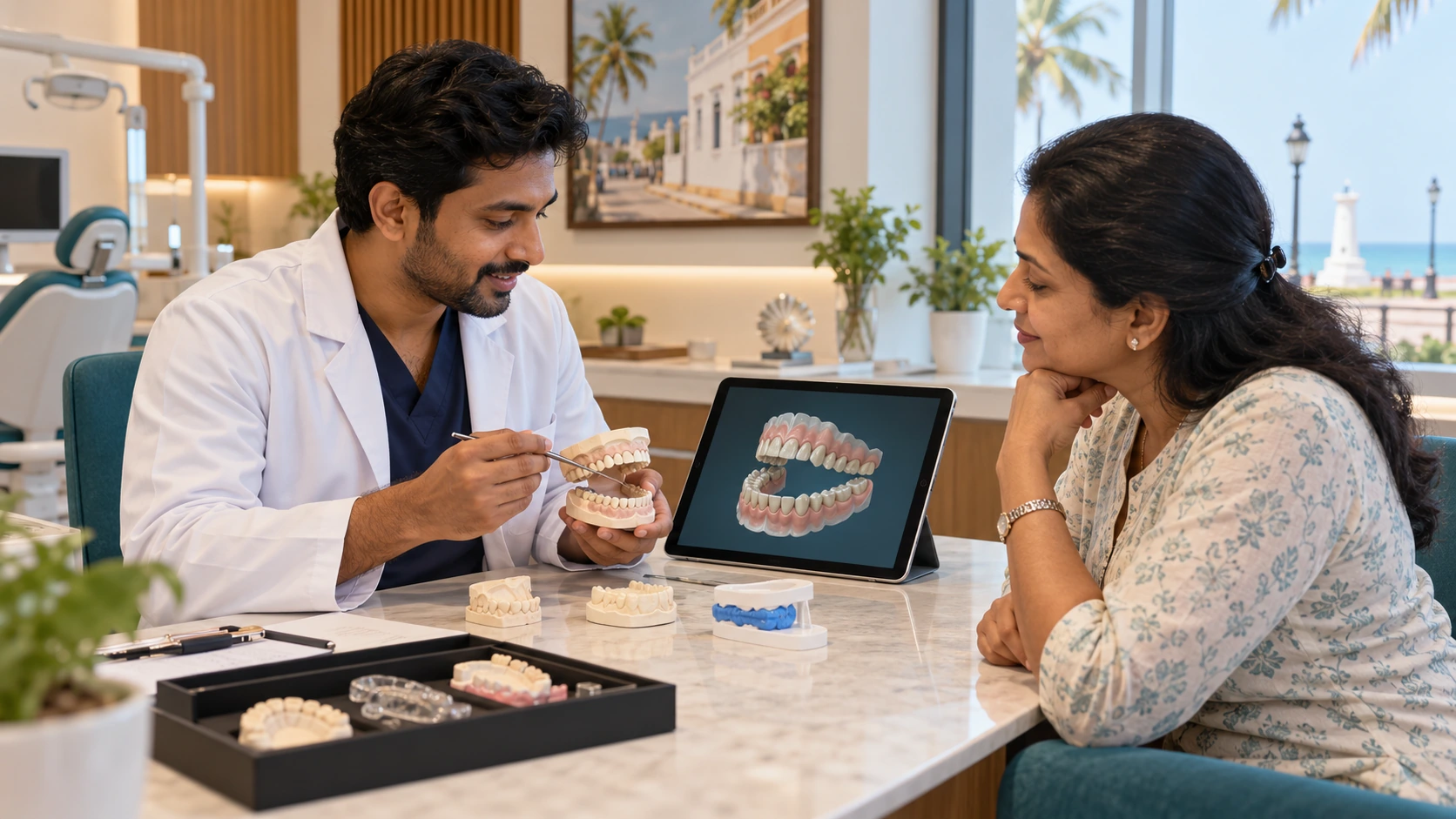
Full Mouth Rehabilitation in Pondicherry: Complete Treatment Guide
Full mouth rehabilitation is a comprehensive approach to restoring the health, function, comfort, and appearance of multiple teeth and oral structures. It may be considered when a person has several dental problems that cannot be effectively addressed with a single treatment.
Full mouth rehabilitation is not one specific dental procedure. Depending on the patient's condition, the treatment plan may combine restorative dentistry, root canal treatment, dental crowns, dental implants, dentures, gum treatment, orthodontic treatment, bite correction, and other procedures.
If you are searching for full mouth rehabilitation in Pondicherry, the first step is a detailed dental examination and treatment-planning consultation.
What Is Full Mouth Rehabilitation?
Full mouth rehabilitation, also called full mouth reconstruction in some clinical settings, involves planning multiple dental treatments to restore oral health and function.
It may address:
- Damaged teeth
- Missing teeth
- Severely worn teeth
- Extensive tooth decay
- Multiple failed restorations
- Gum problems
- Bite problems
- Tooth infections
- Broken teeth
- Tooth loss
- Difficulty chewing
- Functional and aesthetic concerns
The treatment is personalized because every patient's dental condition is different.
Who May Need Full Mouth Rehabilitation?
Full mouth rehabilitation may be considered for patients with multiple or complex dental concerns.
Possible situations include:
- Multiple missing teeth
- Extensive tooth decay
- Severely worn teeth
- Several broken teeth
- Multiple root canal-treated teeth requiring restoration
- Old or failing dental restorations
- Significant bite problems
- Advanced tooth wear
- Multiple dental infections
- Extensive gum problems
- Difficulty chewing
- Combination of functional and cosmetic dental concerns
Not everyone with several dental problems requires full mouth rehabilitation.
A dentist must evaluate the condition of the teeth, gums, supporting bone, bite, and overall oral health before recommending a comprehensive treatment plan.
What Problems Can Full Mouth Rehabilitation Address?
A comprehensive rehabilitation plan may address several problems at the same time.
Missing Teeth
Missing teeth can affect chewing, speech, tooth position, and smile appearance.
Treatment may include:
- Dental implants
- Dental bridges
- Partial dentures
- Complete dentures
- Implant-supported restorations
Damaged Teeth
Broken or weakened teeth may require:
- Dental fillings
- Bonding
- Onlays
- Crowns
- Other restorative procedures
Infected Teeth
Teeth affected by pulp infection may require:
- Root canal treatment
- Final restoration
- Dental crown when appropriate
Severe Tooth Wear
Worn teeth can affect tooth height, bite, sensitivity, chewing, and appearance.
The treatment plan should identify the likely cause of wear before restoring the teeth.
Gum Problems
Healthy gums are important for long-term restorative treatment.
Depending on the condition, gum treatment may be required before final restorations.
Why Is Comprehensive Treatment Planning Important?
Treating multiple teeth individually without considering the entire mouth can create challenges when the teeth, bite, gums, and restorations interact with each other.
A comprehensive plan considers:
- Existing teeth
- Missing teeth
- Tooth position
- Gum health
- Bite
- Jaw relationships
- Tooth wear
- Existing restorations
- Bone support
- Functional requirements
- Aesthetic goals
The sequence of treatment is also important.
Full Mouth Rehabilitation Consultation in Pondicherry
The process usually begins with a detailed consultation.
Your dentist may discuss:
- Your main concerns
- Dental pain or sensitivity
- Difficulty chewing
- Previous dental treatment
- Existing restorations
- Missing teeth
- Smile concerns
- Medical history
- Current medications
- Previous dental records
A comprehensive examination can then be planned.
How Is Full Mouth Rehabilitation Diagnosed?
A dentist may use several forms of evaluation depending on your needs.
Clinical Examination
The dentist examines:
- Teeth
- Gums
- Existing restorations
- Bite
- Tooth mobility
- Tooth wear
- Oral tissues
Dental X-Rays
X-rays may help evaluate:
- Tooth roots
- Bone support
- Tooth decay
- Existing root canal treatment
- Dental infections
- Impacted teeth
Digital Scanning
Digital intraoral scans can provide detailed records of the teeth and bite.
Digital dentistry can support treatment planning and selected restorative workflows.
Photographs
Dental photographs may be used to document:
- Smile
- Tooth appearance
- Tooth proportions
- Gum display
- Existing restorations
Bite Assessment
The relationship between the upper and lower teeth is important when planning extensive restorative treatment.
What Treatments Can Be Included in Full Mouth Rehabilitation?
The treatment combination depends entirely on the patient's condition.
Possible treatments include:
- Dental fillings
- Root canal treatment
- Dental crowns
- Dental bridges
- Dental implants
- Dentures
- Implant-supported dentures
- Gum treatment
- Tooth extraction
- Clear aligners
- Orthodontic treatment
- Tooth wear management
- Cosmetic bonding
- Veneers in selected cases
- Bite correction
- Preventive dental care
Not every patient requires every treatment.
Full Mouth Rehabilitation With Dental Implants
Dental implants may be used to replace missing teeth when the patient is clinically suitable.
An implant can support:
- Single dental crowns
- Implant-supported bridges
- Implant-supported dentures
- Selected full-arch restorations
Implant planning may consider:
- Bone quantity and quality
- Gum health
- Bite
- Number of missing teeth
- Implant position
- Overall health
- Oral hygiene
Implant treatment generally involves multiple stages, including placement, healing, and final restoration.
Full Mouth Rehabilitation With Dental Crowns
Dental crowns may be used to restore teeth that are significantly damaged or weakened.
Crowns can restore:
- Tooth shape
- Tooth strength
- Tooth function
- Tooth colour
- Chewing surfaces
When multiple crowns are planned, the dentist must consider how the restorations work together with the patient's bite and surrounding teeth.
Full Mouth Rehabilitation and Root Canal Treatment
Some patients undergoing comprehensive rehabilitation may have teeth with infected or irreversibly inflamed pulp.
Such teeth may require root canal treatment before receiving their final restoration.
Root canal treatment may involve:
- Diagnosis
- Local anaesthesia
- Accessing the tooth
- Removing affected pulp
- Cleaning the root canals
- Shaping the canals
- Filling and sealing the canals
- Final restoration
The need for root canal treatment should be determined separately for each affected tooth.
Full Mouth Rehabilitation With Dentures
Dentures may be considered when several or all teeth are missing.
Possible options include:
- Complete dentures
- Partial dentures
- Implant-supported dentures
The correct option depends on:
- Remaining teeth
- Gum health
- Bone support
- Bite
- Stability
- Patient expectations
Dentures require regular maintenance and may need adjustment over time.
Full Mouth Rehabilitation for Severely Worn Teeth
Severe tooth wear can affect both function and appearance.
Possible causes include:
- Teeth grinding
- Erosion
- Abrasion
- Certain bite patterns
- Other dental or lifestyle factors
The underlying cause should be identified before extensive restorative treatment.
Treatment may involve:
- Restorations
- Crowns
- Bonding
- Bite management
- Protective appliances
- Treatment of the underlying cause
Full Mouth Rehabilitation for Multiple Missing Teeth
When several teeth are missing, a comprehensive plan can evaluate all replacement options.
Depending on the situation, treatment may include:
- Dental implants
- Implant-supported bridges
- Conventional bridges
- Partial dentures
- Complete dentures
The dentist will consider the remaining teeth and supporting tissues before recommending a treatment approach.
Full Mouth Rehabilitation for Broken Teeth
Multiple broken teeth may result from:
- Trauma
- Tooth decay
- Large restorations
- Teeth grinding
- Severe tooth wear
- Other structural problems
The treatment depends on how much healthy tooth structure remains.
Possible treatments include:
- Bonding
- Fillings
- Onlays
- Crowns
- Root canal treatment
- Dental implants after extraction when required
Full Mouth Rehabilitation and Gum Treatment
Healthy gums are an important foundation for extensive restorative dentistry.
If gum inflammation or periodontal disease is present, it may need to be addressed before final restorative treatment.
Gum treatment may include:
- Professional cleaning
- Scaling
- Root surface treatment
- Periodontal maintenance
- Other gum procedures when clinically required
The treatment plan depends on the severity and type of gum condition.
Full Mouth Rehabilitation and Bite Correction
The bite describes how the upper and lower teeth meet.
A comprehensive rehabilitation may need to consider:
- Bite stability
- Tooth contacts
- Jaw relationships
- Tooth wear
- Missing teeth
- Existing restorations
- Chewing function
In selected cases, orthodontic treatment or clear aligners may be considered before restorative treatment.
Can Clear Aligners Be Part of Full Mouth Rehabilitation?
Yes, clear aligners or orthodontic treatment may sometimes form part of a comprehensive rehabilitation plan.
Moving teeth before restorative treatment can sometimes help improve:
- Tooth position
- Spacing
- Alignment
- Restorative space
- Overall treatment planning
Clear aligners are not suitable for every case.
A complete orthodontic and dental assessment is necessary before treatment.
Is Full Mouth Rehabilitation the Same as a Smile Makeover?
No.
There can be some overlap, but the goals are different.
Smile Makeover
A smile makeover primarily focuses on improving smile appearance.
It may include:
- Teeth whitening
- Veneers
- Bonding
- Smile Design
- Crowns
- Aligners
Full Mouth Rehabilitation
Full mouth rehabilitation focuses more broadly on:
- Oral health
- Function
- Missing teeth
- Damaged teeth
- Bite
- Tooth wear
- Restorations
- Gum health
- Long-term dental stability
A full mouth rehabilitation can include cosmetic improvements, but health and function are important parts of the treatment plan.
Is Full Mouth Rehabilitation Painful?
The experience depends on which procedures are included.
Some treatments may involve little or no discomfort, while procedures such as extractions, implants, gum treatment, or tooth preparation may require local anaesthesia.
Your dentist should explain:
- What each procedure involves
- Expected discomfort
- Anaesthesia options
- Recovery
- Aftercare
- Follow-up appointments
How Long Does Full Mouth Rehabilitation Take?
There is no single treatment duration.
The timeline depends on:
- Number of teeth involved
- Number of missing teeth
- Gum condition
- Tooth infections
- Root canal treatment
- Implant treatment
- Bone healing
- Orthodontic treatment
- Laboratory restorations
- Number of appointments
- Overall treatment complexity
Some patients may complete certain stages quickly, while complex rehabilitation can take several months.
A personalized timeline can only be estimated after diagnosis and treatment planning.
Why Can Full Mouth Rehabilitation Take Several Months?
Comprehensive treatment often involves several stages.
For example:
- Treating active infection
- Controlling gum disease
- Completing root canals
- Extracting non-restorable teeth
- Allowing healing
- Placing implants
- Waiting for implant integration
- Completing temporary restorations
- Fabricating final crowns or bridges
- Completing orthodontic movement
- Performing final bite adjustments
Healing and laboratory fabrication cannot always be shortened simply by scheduling more appointments.
What Is the Treatment Sequence?
A typical comprehensive plan may follow a sequence such as:
Step 1: Examination
Evaluate the complete mouth.
Step 2: Diagnosis
Identify dental, gum, bite, and functional problems.
Step 3: Treatment Planning
Develop a personalized sequence based on priorities.
Step 4: Disease Control
Treat active infections, decay, and gum problems.
Step 5: Stabilization
Restore teeth that can be preserved and stabilize the mouth.
Step 6: Tooth Replacement
Replace missing teeth using appropriate options.
Step 7: Definitive Restorations
Place final crowns, bridges, dentures, or implant-supported restorations.
Step 8: Bite Evaluation
Check comfort, function, and tooth contacts.
Step 9: Maintenance
Continue regular dental examinations and professional maintenance.
The exact sequence can vary significantly between patients.
Temporary Teeth During Full Mouth Rehabilitation
Temporary restorations may be used during some comprehensive treatment plans.
They can help:
- Protect prepared teeth
- Maintain appearance
- Support function
- Test tooth shape
- Evaluate bite
- Guide final restoration design
Temporary restorations are not always required for every treatment.
Digital Dentistry in Full Mouth Rehabilitation
Digital technology can support comprehensive dental planning.
Depending on the treatment, digital tools may include:
- Intraoral scanning
- Digital photographs
- Digital bite records
- CAD/CAM restoration design
- Digital treatment planning
- Computer-assisted laboratory workflows
Digital technology can improve records and communication, but clinical examination and professional judgment remain essential.
What Are the Benefits of Full Mouth Rehabilitation?
Potential benefits depend on the treatments required.
A comprehensive plan may help:
- Restore chewing function
- Replace missing teeth
- Repair damaged teeth
- Treat dental infections
- Improve bite stability
- Improve smile appearance
- Address severe tooth wear
- Improve oral comfort
- Organize complex dental treatment
Results depend on the patient's dental condition, treatment plan, healing, oral hygiene, and long-term maintenance.
What Are the Risks of Full Mouth Rehabilitation?
Extensive dental treatment can involve risks that vary according to the procedures performed.
Potential considerations may include:
- Temporary sensitivity
- Gum tenderness
- Restoration fracture
- Implant complications
- Bite adjustment requirements
- Treatment delays
- Need for maintenance
- Future restoration replacement
Your dentist should explain procedure-specific risks before treatment.
How Much Does Full Mouth Rehabilitation Cost in Pondicherry?
There is no standard fixed cost for full mouth rehabilitation.
The total cost depends on:
- Number of teeth involved
- Number of missing teeth
- Dental materials
- Root canal treatment
- Crowns
- Dental implants
- Dentures
- Gum treatment
- Extractions
- Orthodontic treatment
- Digital planning
- Laboratory work
- Treatment complexity
- Number of appointments
An accurate estimate requires examination and treatment planning.
Why Does Full Mouth Rehabilitation Cost Differ Between Patients?
Every comprehensive dental case is different.
One patient may need:
- Several crowns
- Two root canals
- Gum treatment
Another patient may need:
- Multiple implants
- Bone-related procedures
- Implant-supported restorations
- Dentures
Therefore, online package prices should not be used as a substitute for a personalized treatment estimate.
How to Choose a Full Mouth Rehabilitation Dentist in Pondicherry
When considering comprehensive dental treatment, look for:
Detailed Diagnosis
The dentist should explain the problems identified during the examination.
Comprehensive Planning
The treatment should consider the entire mouth rather than isolated teeth.
Clear Treatment Sequence
You should understand what will happen first, next, and later.
Alternatives
Ask whether there are alternative treatment approaches.
Transparent Costs
Request an explanation of the expected treatment scope and associated costs.
Long-Term Maintenance
Understand how the teeth, implants, crowns, dentures, and gums will need to be maintained.
Questions to Ask Before Full Mouth Rehabilitation
Before beginning treatment, ask:
- What problems need to be treated?
- Which teeth can be saved?
- Which teeth cannot be restored?
- What are the treatment alternatives?
- Which procedures are essential?
- Which treatments are optional?
- How many appointments are expected?
- Will temporary teeth be required?
- Will implants be needed?
- Will I need root canal treatment?
- Will crowns be required?
- How long will the overall treatment take?
- What will the estimated treatment cost include?
- What maintenance will be required after treatment?
Understanding the complete plan can help you prepare for a long-term treatment journey.
Why Choose Smile and Glow Dental Care for Full Mouth Rehabilitation in Pondicherry?
Smile and Glow Dental Care provides comprehensive dental care in Pondicherry, covering restorative, endodontic, implant, crown, denture, orthodontic, cosmetic, and preventive dental needs.
The clinic's broader dental services include:
- Root canal treatment
- Dental implants
- Dental crowns
- Dentures
- Clear aligners
- Cosmetic dentistry
- Smile Design
- Preventive dental care
- Emergency dental care
A comprehensive treatment plan can be developed according to the patient's individual dental condition and treatment requirements.
Full Mouth Rehabilitation Consultation in Pondicherry
If you have multiple dental problems, treating each problem separately may not always provide the most coordinated approach.
A comprehensive consultation can help evaluate:
- Teeth
- Gums
- Missing teeth
- Existing restorations
- Bite
- Tooth wear
- Dental infections
- Smile appearance
- Functional concerns
The dentist can then explain the diagnosis, treatment options, sequence, expected appointments, and maintenance requirements.
How to Maintain Results After Full Mouth Rehabilitation
Long-term maintenance is an important part of comprehensive dental treatment.
After rehabilitation:
- Brush twice daily
- Clean between your teeth
- Attend regular dental checkups
- Maintain gum health
- Follow professional cleaning recommendations
- Avoid biting hard non-food objects
- Do not use teeth to open packages
- Manage teeth grinding when advised
- Follow implant or denture care instructions
- Replace retainers or protective appliances when required
Your natural teeth and dental restorations both require ongoing care.
Final Thoughts: Full Mouth Rehabilitation in Pondicherry
Full mouth rehabilitation is a personalized approach for patients with multiple dental problems affecting oral health, function, comfort, appearance, or a combination of these concerns.
It may combine:
- Root canal treatment
- Dental crowns
- Dental implants
- Bridges
- Dentures
- Gum treatment
- Orthodontic treatment
- Clear aligners
- Restorative dentistry
- Bite management
- Cosmetic dental procedures
The most important step is not choosing a procedure first.
It is receiving a comprehensive examination and understanding the condition of your teeth, gums, bite, and supporting structures.
If you are considering full mouth rehabilitation in Pondicherry, schedule a professional consultation to discuss your dental concerns and develop a personalized treatment plan.
Frequently Asked Questions
What is full mouth rehabilitation?
Full mouth rehabilitation is a comprehensive dental treatment approach that combines multiple procedures to restore oral health, function, comfort, and appearance.
Who needs full mouth rehabilitation?
It may be considered for patients with multiple missing, damaged, infected, worn, or heavily restored teeth, significant bite problems, gum problems, or several dental concerns requiring coordinated treatment.
What treatments are included in full mouth rehabilitation?
Depending on the patient's needs, treatment may include root canals, crowns, dental implants, bridges, dentures, gum treatment, fillings, orthodontics, clear aligners, tooth replacement, and selected cosmetic procedures.
Is full mouth rehabilitation the same as a smile makeover?
No. A smile makeover primarily focuses on smile appearance, while full mouth rehabilitation addresses broader oral health and functional concerns along with aesthetics when required.
Can dental implants be part of full mouth rehabilitation?
Yes. Dental implants may be included when missing teeth need replacement and the patient is clinically suitable for implant treatment.
Can root canal treatment be part of full mouth rehabilitation?
Yes. Teeth with infected or irreversibly inflamed pulp may require root canal treatment before receiving their final restoration.
How long does full mouth rehabilitation take?
The timeline varies significantly. Complex cases involving implants, root canals, gum treatment, orthodontics, healing, and laboratory restorations may require several months.
How much does full mouth rehabilitation cost in Pondicherry?
There is no fixed price because treatment depends on the number of teeth, procedures, materials, implants, restorations, laboratory work, and overall complexity. A consultation is required for an accurate estimate.
Is full mouth rehabilitation painful?
The experience depends on the procedures involved. Local anaesthesia can be used for many dental procedures, and your dentist will explain expected discomfort and recovery for each stage.
Can full mouth rehabilitation improve chewing?
Yes. One of the major goals of comprehensive rehabilitation can be restoring or improving chewing function through appropriate treatment and tooth replacement.
Can full mouth rehabilitation improve the appearance of my smile?
It can. Depending on the treatment plan, crowns, implants, dentures, orthodontics, bonding, veneers, or other cosmetic procedures may improve smile appearance.
Where can I get full mouth rehabilitation in Pondicherry?
Smile and Glow Dental Care provides comprehensive dental treatment in Pondicherry, including restorative dentistry, root canal treatment, crowns, implants, dentures, aligners, cosmetic dentistry, and other treatments that may form part of an individualized rehabilitation plan.