


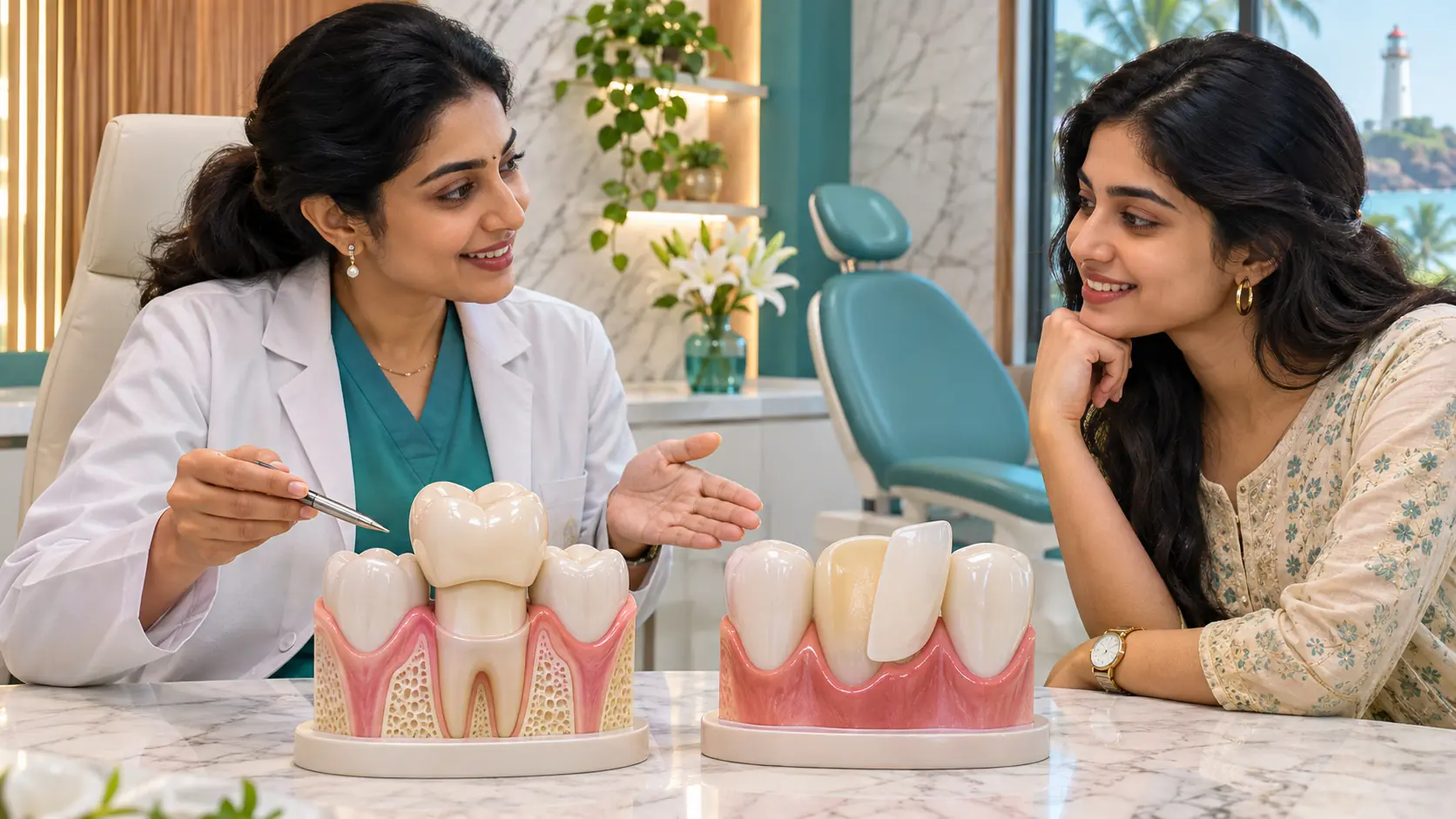
How to Choose Between Dental Crowns and Veneers in Pondicherry
Dental crowns and veneers can both improve a tooth’s appearance, but they serve different purposes. A veneer primarily changes the visible front surface of a relatively healthy tooth, while a crown surrounds most or all of a prepared tooth to restore strength, shape and function.
Choosing between dental crowns and veneers in Pondicherry should be based on the condition of the tooth—not appearance alone. The amount of healthy enamel, decay, cracks, existing fillings, bite forces, gum health and cosmetic goals all influence the decision.
At Smile & Glow Dental Care, each tooth can be assessed individually before a conservative and suitable treatment is recommended.
Quick Answer: Should You Choose a Crown or Veneer?
A veneer may be considered when:
- The tooth is relatively healthy and structurally intact
- The main concern is colour, shape or a minor chip
- A small gap needs cosmetic correction
- Sufficient enamel is available for bonding
- The bite does not place excessive force on the veneer
A crown may be considered when:
- A tooth has a large filling
- Significant tooth structure has been lost
- The tooth is cracked or badly broken
- Severe wear has weakened the tooth
- The tooth needs broader protection
- A root-treated tooth requires reinforcement based on its condition
- A dental implant needs an artificial tooth restoration
The most conservative treatment that can predictably protect the tooth is generally preferred.
What Is a Dental Veneer?
A veneer is a thin, custom-made covering bonded to the front surface of a tooth. It is most commonly used on visible front teeth.
Veneers may help improve the appearance of teeth that are:
- Permanently discoloured
- Chipped
- Worn at the edges
- Mildly misshapen
- Uneven in size
- Separated by small spaces
- Slightly misaligned in selected cases
A veneer does not completely surround the tooth. It mainly changes the visible front surface and sometimes extends slightly around the sides or biting edge.
What Is a Dental Crown?
A dental crown, sometimes called a cap, covers most or all of a prepared natural tooth.
A crown may be used to:
- Protect a weakened tooth
- Restore a badly broken tooth
- Rebuild a severely worn tooth
- Cover and support a tooth with a large filling
- Restore selected root-treated teeth
- Improve a severely misshapen tooth
- Support a dental bridge
- Restore a dental implant
- Correct function as well as appearance
Because a crown surrounds more of the tooth, it usually requires more tooth preparation than a veneer.
Main Difference Between Crowns and Veneers
The primary difference is the amount of tooth coverage.
Veneer
- Covers mainly the front surface
- Primarily used for cosmetic improvement
- Usually requires less tooth reduction than a crown
- Depends heavily on healthy enamel for bonding
- Commonly used on front teeth
- Offers limited reinforcement for a severely weakened tooth
Crown
- Covers most or all of the tooth
- Restores strength, shape and function
- Usually requires more tooth preparation
- Can protect teeth with extensive structural damage
- May be used on front or back teeth
- Can support a bridge or restore an implant
Neither option is automatically better. They solve different clinical problems.
When May a Veneer Be the Better Choice?
A veneer may be appropriate when the tooth is largely intact and the concern is primarily cosmetic.
Possible situations include:
- Stains that do not respond adequately to whitening
- A small chip
- Mild front-tooth wear
- Uneven tooth shape
- Minor differences in tooth length
- Small spaces between front teeth
- A tooth that appears slightly rotated or irregular
- A desire to improve smile symmetry
The dentist must confirm that enough healthy enamel is present for reliable bonding.
Veneers may not be appropriate when the tooth has extensive decay, a very large filling, a deep crack or insufficient enamel.
When May a Crown Be the Better Choice?
A crown may be appropriate when a tooth requires structural protection as well as cosmetic improvement.
Possible indications include:
- A large cavity
- A large or failing filling
- Significant fracture
- A weakened cusp
- Severe tooth wear
- Substantial loss of tooth structure
- A tooth that cannot predictably hold another filling
- Selected root-treated teeth
- A dental implant
- A bridge-supporting tooth
The dentist should still consider whether a filling, inlay, onlay or another conservative restoration could preserve more natural tooth structure.
Crowns or Veneers for Front Teeth
Both options can be used on front teeth, but the choice depends on tooth condition.
A veneer may be preferred when:
- Most of the tooth is healthy
- Enamel is available for bonding
- The change is mainly cosmetic
- The bite is favourable
A crown may be preferred when:
- The tooth is extensively restored
- A large part is broken
- A crack affects strength
- The tooth has severe wear
- There is insufficient enamel for predictable veneer bonding
- The tooth needs full coverage
Front-tooth restorations also require careful shade, shape, surface texture and gumline planning.
Crowns or Veneers for Back Teeth
Veneers are primarily associated with visible front surfaces. Back teeth receive stronger chewing forces and often require restorations designed for load-bearing function.
A crown or onlay may be considered for a damaged back tooth, depending on:
- Amount of remaining tooth structure
- Size of the existing filling
- Location of cracks
- Bite forces
- Grinding habits
- Condition of the tooth nerve
- Ability to isolate and bond the restoration
Not every back tooth with a filling needs a crown. Treatment should be proportionate to the amount of damage.
Porcelain Veneers and Composite Veneers
Porcelain Veneers
Porcelain or ceramic veneers are thin laboratory-made shells bonded to prepared teeth.
Possible advantages include:
- Natural-looking translucency
- Good colour stability
- Resistance to external staining
- Custom control of shape and shade
- Longer service than composite in many suitable cases
Possible limitations include:
- Irreversible tooth preparation in most cases
- Higher cost than composite bonding
- Potential to chip or fracture
- More difficult repair
- Multiple appointments may be required
- Replacement may be necessary in the future
Composite Veneers
Composite veneers are made using tooth-coloured resin placed and shaped directly on the tooth.
Possible advantages include:
- Less tooth preparation in selected cases
- Often completed in fewer visits
- Easier to repair
- Lower initial cost than porcelain
- Useful for minor chips or shape corrections
Possible limitations include:
- More likely to stain
- May wear faster
- Can chip
- Requires polishing and maintenance
- May not reproduce the same translucency as ceramic
The most suitable material depends on the desired change, bite and available tooth structure.
Types of Dental Crowns
Crowns may be made using:
- All-ceramic materials
- Zirconia
- Porcelain fused to metal
- Metal alloys
- Resin-based temporary materials
Material selection depends on:
- Tooth location
- Appearance requirements
- Bite forces
- Available space
- Grinding habits
- Gumline position
- Remaining tooth structure
- Material allergies
- Opposing teeth
- Cost
No material is ideal for every patient or every tooth.
How Much Tooth Structure Is Removed?
Veneers generally require less preparation because they cover mainly the front surface. However, most conventional veneer treatment is still irreversible once enamel has been removed.
Crowns usually require reduction around the tooth to create space for the restorative material and provide an appropriate shape for retention.
The exact amount depends on:
- Restoration material
- Tooth position
- Existing fillings
- Damage
- Desired colour change
- Bite clearance
- Previous treatment
Patients should be cautious of any treatment that recommends extensive preparation of healthy teeth without discussing conservative alternatives.
Are No-Preparation Veneers Suitable for Everyone?
No-preparation or minimal-preparation veneers may be possible in selected cases, but they are not appropriate for every smile.
If placed on unsuitable teeth, they may:
- Look bulky
- Create an over-contoured appearance
- Affect gum health
- Change the bite
- Make cleaning more difficult
Tooth position, existing shape, gumline and desired result determine whether minimal preparation is realistic.
Do Crowns Require Root Canal Treatment?
No. A crown does not automatically require root canal treatment.
Root canal treatment is recommended only when the tooth’s pulp is irreversibly inflamed, infected or otherwise clinically requires treatment.
However, crown preparation on a heavily damaged tooth can sometimes be associated with future nerve problems. The dentist should evaluate symptoms, X-rays, decay depth and remaining tooth structure before treatment.
Can Veneers Be Placed Over Decay or Gum Disease?
No. Active decay and gum disease should be treated before veneers or crowns are placed.
Covering an unhealthy tooth does not remove the disease. Untreated decay may progress beneath a restoration, while inflamed gums can affect:
- Bonding
- Gumline appearance
- Impression accuracy
- Final fit
- Cleaning
- Long-term stability
Stable gum health is particularly important for cosmetic front-tooth treatment.
Crowns and Veneers for Crooked Teeth
Veneers or crowns can visually change the shape of mildly irregular teeth, but they do not physically move tooth roots.
When teeth are significantly crowded, rotated or associated with an incorrect bite, orthodontic treatment may be a more conservative choice.
Braces or clear aligners may improve alignment without removing healthy tooth structure. Cosmetic restoration can then be considered for any remaining shape or colour concerns.
Crowns and Veneers for Discoloured Teeth
Before choosing a restoration, the dentist should determine why a tooth is discoloured.
Possible causes include:
- External staining
- Age-related colour change
- Previous dental trauma
- Root canal treatment
- Medication-related staining
- Enamel-development conditions
- Existing fillings
- Tooth decay
Professional cleaning or whitening may be sufficient for some patients. A single dark root-treated tooth may require a different approach from generalised yellowing.
Veneers or crowns may be considered when conservative colour treatment cannot achieve the desired result or when the tooth also needs structural restoration.
Which Option Looks More Natural?
Both crowns and veneers can look natural when correctly planned, prepared and fabricated.
The final appearance depends on:
- Material quality
- Tooth preparation
- Shade selection
- Surface texture
- Translucency
- Gum health
- Laboratory work
- Bonding or cementation
- Symmetry with neighbouring teeth
- Dentist and technician communication
Veneers can offer highly natural front-tooth aesthetics because they preserve more underlying tooth structure in suitable cases. Crowns can also provide excellent aesthetics when full coverage is clinically required.
How Long Do Crowns and Veneers Last?
Neither crowns nor veneers should be considered lifetime treatments.
Longevity depends on:
- Remaining tooth structure
- Quality of bonding or cementation
- Oral hygiene
- Gum health
- Bite forces
- Teeth grinding
- Diet
- Smoking
- Material
- Dental decay
- Accidents or trauma
- Regular maintenance
Both restorations may eventually chip, loosen, wear or require replacement.
Replacing a restoration may involve additional treatment, which is why the initial decision should preserve as much healthy tooth structure as reasonably possible.
Possible Risks of Dental Veneers
Potential risks include:
- Temporary or persistent sensitivity
- Chipping
- Cracking
- Debonding
- Staining around the margins
- Gum irritation
- Decay around or beneath the veneer
- Uneven colour
- Bite discomfort
- Need for replacement
- Difficulty matching a single veneer
- Limited repair options for porcelain
Patients who grind their teeth or have an unfavourable bite may face a higher risk of veneer damage.
Possible Risks of Dental Crowns
Potential risks include:
- Tooth sensitivity
- Gum irritation
- Decay at the crown margin
- Crown fracture
- Ceramic chipping
- Cement failure
- Crown loosening
- Bite discomfort
- Future root canal treatment
- Fracture of the underlying tooth
- Need for replacement
- Loss of the tooth if it becomes unrestorable
A crown protects a damaged tooth but does not make it immune to decay, gum disease or fracture.
Can Teeth Grinding Affect Crowns and Veneers?
Yes. Clenching and grinding can place heavy forces on restorations.
Possible consequences include:
- Chipped porcelain
- Cracked veneers
- Worn opposing teeth
- Debonding
- Crown fracture
- Jaw-muscle pain
- Headaches
- Restoration failure
The dentist may recommend bite adjustment, management of contributing factors or a custom night guard.
A night guard may reduce damage but cannot guarantee that a restoration will never fracture.
What Is the Treatment Process?
Veneer Treatment
Treatment may involve:
- Examination and smile assessment
- Photographs and digital planning
- Treatment of decay or gum disease
- Shade selection
- Conservative tooth preparation
- Digital scan or impression
- Temporary veneer when required
- Trial fitting
- Final bonding
- Bite adjustment
- Review appointment
Composite veneers may sometimes be completed directly in one visit.
Crown Treatment
Treatment may involve:
- Examination and dental X-ray
- Treatment of decay or infection
- Building up the tooth when required
- Tooth preparation
- Digital scan or impression
- Temporary crown
- Laboratory fabrication
- Final fit and bite check
- Cementation or bonding
- Review appointment
Some clinics may offer same-day crowns using digital manufacturing, but this is not appropriate or available for every case.
How Do You Care for Crowns and Veneers?
Patients should:
- Brush twice daily with fluoride toothpaste
- Clean between teeth every day
- Clean carefully along restoration margins
- Avoid biting fingernails
- Avoid chewing ice or hard objects
- Use scissors rather than teeth to open packages
- Wear a sports mouthguard when required
- Wear a night guard if prescribed
- Limit frequent sugary food and drinks
- Attend dental reviews
- Report looseness, sensitivity or bite changes
The tooth beneath a crown or veneer can still develop decay near the margin.
Alternatives to Crowns and Veneers
Depending on the concern, alternatives may include:
- No treatment
- Professional cleaning
- Teeth whitening
- Composite bonding
- Enamel recontouring
- Orthodontic treatment
- A filling
- Inlay or onlay
- Root canal treatment followed by an appropriate restoration
- Extraction and replacement when a tooth cannot be saved
A conservative option may be preferable when it can predictably achieve the required result.
How Much Do Crowns and Veneers Cost in Pondicherry?
Cost varies according to:
- Number of teeth
- Restoration type
- Material
- Extent of preparation
- Existing decay or gum treatment
- Root canal or foundation treatment
- Digital smile planning
- Laboratory work
- Temporary restorations
- Complexity of shade matching
- Night-guard requirements
- Follow-up and maintenance
A crown used to restore a severely damaged tooth and a veneer used for cosmetic improvement involve different clinical requirements. An examination is necessary before an accurate estimate can be provided.
How Should You Make the Final Decision?
Ask the dentist:
- Is the tooth structurally healthy?
- How much natural tooth will be removed?
- Is a filling, bonding, onlay or whitening treatment possible?
- Is orthodontic treatment a better option?
- Will my bite affect the restoration?
- Do I grind my teeth?
- Will I need a night guard?
- How will the restoration be maintained?
- What happens if it chips or fails?
- Will future replacement remove more tooth structure?
- What result is realistically achievable?
The decision should protect long-term tooth health rather than focus only on the fastest cosmetic change.
Crown and Veneer Consultation at Smile & Glow Dental Care
Smile & Glow Dental Care provides personalised assessment for dental crowns and veneers in Pondicherry.
Care may include:
- Complete dental examination
- Gum-health assessment
- Evaluation of decay and existing fillings
- Bite analysis
- Teeth-grinding assessment
- Shade and smile planning
- Crown and veneer comparison
- Discussion of conservative alternatives
- Material selection
- Aftercare and maintenance planning
The goal is to choose an option that restores the tooth while preserving as much healthy natural structure as reasonably possible.
Frequently Asked Questions
Is a Crown Better Than a Veneer?
Not automatically. A crown is generally more appropriate for a weakened or extensively damaged tooth, while a veneer may suit a relatively healthy tooth requiring cosmetic improvement.
Which Removes More Tooth Structure?
A crown usually requires more tooth reduction because it covers most or all of the tooth. A veneer generally requires less preparation and covers mainly the front surface.
Can Veneers Fix Crooked Teeth?
Veneers can visually mask minor irregularities, but they do not move tooth roots or correct significant bite problems. Braces or clear aligners may be more appropriate for substantial misalignment.
Can a Veneer Be Replaced With a Crown Later?
It may be possible if the tooth requires greater coverage later, but the decision depends on the remaining tooth structure, decay, bite and nerve health.
Do Crowns or Veneers Develop Cavities?
The restorative material does not decay, but the natural tooth can develop decay at or beneath the restoration margin. Daily cleaning and dental reviews remain essential.
Do Crowns Always Need Root Canal Treatment?
No. Root canal treatment is required only when the tooth’s pulp is irreversibly inflamed, infected or otherwise needs treatment.
Which Lasts Longer: A Crown or Veneer?
Longevity varies with material, tooth condition, bite, oral hygiene and grinding. Neither option lasts forever, and both may eventually need repair or replacement.
Can I Whiten Crowns or Veneers?
No. Whitening agents lighten natural teeth but do not change the shade of crowns, veneers or fillings. Whitening is often planned before selecting the shade of new restorations.
Book a Crown and Veneer Consultation in Pondicherry
If you are deciding between a crown and veneer, schedule an assessment at Smile & Glow Dental Care in Pondicherry.
A clinical examination can determine whether your tooth needs cosmetic surface improvement, structural protection or a more conservative alternative. You can then compare preparation, appearance, risks, maintenance and cost before making a decision.
This article provides general educational information and does not replace a clinical examination, diagnosis or personalised treatment plan from a qualified dentist.