


Failed Root Canal Retreatment in Pondicherry to Save Teeth
Root canal treatment is performed to remove infected tissue from inside a tooth, disinfect the root canals and preserve the natural tooth. Although treatment is generally successful, a tooth may occasionally fail to heal as expected or develop a new infection months or years later.
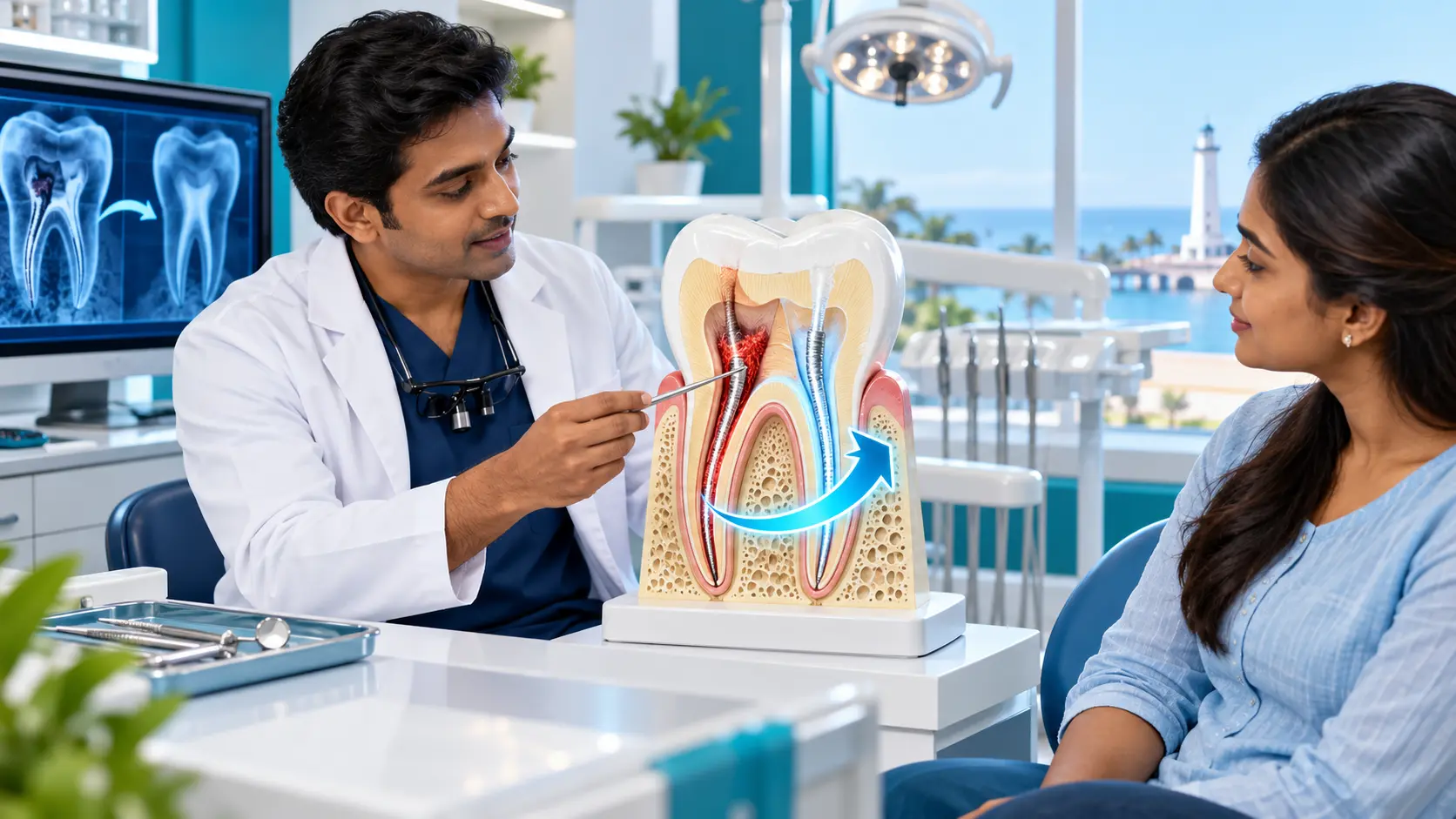
Root canal retreatment involves reopening the previously treated tooth, removing the old root-filling material, locating untreated or reinfected canals, disinfecting the canal system and sealing it again.
Retreatment of a failed root canal in Pondicherry may offer a second opportunity to control infection and save the natural tooth. However, a detailed examination is necessary to determine whether retreatment, root-end surgery or extraction is the most appropriate option.
What Is a Failed Root Canal?
A failed root canal is a previously treated tooth that has not healed properly or has developed a new problem after treatment.
Failure does not always mean the original procedure was performed incorrectly. Root-canal systems can contain narrow, curved or hidden canals that are difficult to identify and treat. A tooth can also become reinfected because of new decay, restoration failure or fracture.
A failed root canal may be identified through symptoms, dental examination or changes visible on an X-ray.
What Are the Symptoms of a Failed Root Canal?
Possible warning signs include:
- Pain in a previously treated tooth
- Pain while biting or chewing
- Tenderness when the tooth is touched
- Swelling near the treated tooth
- A pimple-like bump on the gum
- Discharge or a bad taste
- Facial swelling
- Recurrent dental abscess
- Loosening of a crown or filling
- Discolouration of the tooth
- Return of symptoms experienced before treatment
- Persistent tenderness around the root
- Changes visible on a dental X-ray
Some failed root canals do not cause immediate pain. Infection around the root may sometimes be detected only during a routine dental examination.
Why Can a Root Canal Treatment Fail?
A root canal-treated tooth may fail to heal for several reasons.
Untreated or missed canals
Some teeth have complex internal anatomy. Narrow, curved, calcified or additional canals may not have been identified during the first treatment.
Persistent bacteria
Bacteria may remain in areas of the canal system that were difficult to clean or seal.
Delayed final restoration
A root canal-treated tooth usually needs a permanent filling, onlay or crown to seal and protect it. Delaying the final restoration may allow bacteria to enter the tooth.
Leaking filling or crown
A loose, broken or poorly sealed restoration can allow saliva and bacteria to reach the root-canal filling.
New tooth decay
Decay developing around a crown or filling may expose the internal tooth structure to new infection.
Tooth fracture
A cracked tooth or root fracture can create a pathway for bacteria. Some fractures may make the tooth unsuitable for retreatment.
Damaged dental restoration
A fractured filling, crown or post may compromise the seal and weaken the tooth.
Complex previous treatment
Blocked canals, broken instruments, posts, perforations or heavily altered tooth structure can make retreatment more difficult.
How Is a Failed Root Canal Diagnosed?
Diagnosis begins with a detailed examination of the tooth and surrounding tissues.
The dentist may:
- Review the original root canal history
- Ask when the symptoms started
- Check for pain while biting
- Examine the gum for swelling or drainage
- Assess the crown or filling
- Check for new decay
- Evaluate tooth mobility
- Look for possible cracks
- Compare the tooth with nearby teeth
- Take dental X-rays
In complex cases, three-dimensional CBCT imaging may be recommended to evaluate the root anatomy, hidden canals, bone changes, fractures or previous treatment.
The dentist must also determine whether enough healthy tooth structure remains for a successful final restoration.
What Happens During Root Canal Retreatment?
Root canal retreatment is usually more complex than the original procedure.
Examination and treatment planning
The dentist or endodontic professional evaluates the tooth, previous restoration, root filling and surrounding bone. The benefits, limitations and alternatives are discussed before treatment begins.
Local anaesthesia
The treatment area is numbed to keep the patient comfortable.
Tooth isolation
A rubber dam is placed around the tooth. It keeps the treatment area dry and helps prevent saliva and bacteria from entering the tooth.
Accessing the root canals
The dentist reopens the tooth. An existing filling, crown, post or core may need to be removed or modified to reach the canals.
Removing the old root filling
Previous root-filling material is carefully removed from the canals.
Identifying untreated anatomy
Magnification and illumination may be used to look for missed, narrow or additional canals.
Cleaning and disinfecting
The canals are cleaned, shaped and disinfected to reduce bacteria and remove infected material.
Medication between appointments
If the infection is extensive, medication may be placed inside the canals and the tooth temporarily sealed. A second appointment may be required.
Refilling the canals
After cleaning, the canals are filled and sealed using new root-filling material.
Temporary or permanent restoration
The access opening is sealed. A temporary filling may be placed until a permanent restoration can be completed.
Final crown or restoration
A new crown, onlay or filling may be required to protect the tooth and create a strong seal. This final restoration should be completed within the timeframe recommended by the dentist.
Is Root Canal Retreatment Painful?
Root canal retreatment is usually performed under local anaesthesia. Patients should not normally feel sharp pain during the procedure, although pressure and vibration may be noticed.
The tooth and surrounding area may feel tender for several days afterwards. The dentist will provide instructions for managing discomfort safely.
Contact the clinic if you experience:
- Severe pain that does not improve
- Increasing swelling
- Fever
- Difficulty swallowing
- Difficulty breathing
- An uneven bite
- Loss of the temporary filling
- Return of previous symptoms
- A reaction to prescribed medication
How Many Appointments Are Required?
The number of appointments depends on:
- Number and shape of the roots
- Severity of infection
- Presence of missed canals
- Existing crown or post
- Blocked or calcified canals
- Broken instruments
- Need for medication between visits
- Condition of the surrounding bone
Some retreatments can be completed in one visit, while complex or infected teeth may require multiple appointments.
Can Every Failed Root Canal Be Retreated?
Not every tooth is suitable for retreatment.
Retreatment may be possible when:
- The tooth has sufficient healthy structure
- The root canals can be accessed
- The infection can be cleaned
- The tooth can be permanently restored
- The supporting bone and gums are adequate
- No untreatable root fracture is present
Retreatment may not be suitable when:
- The root has a severe vertical fracture
- Too little natural tooth structure remains
- The tooth has advanced gum or bone loss
- The canals cannot be safely accessed
- The tooth cannot support a final restoration
- Previous damage makes the outcome unpredictable
A dentist or endodontic professional will explain the expected benefits, risks and likelihood of saving the tooth.
What Are the Alternatives to Root Canal Retreatment?
When nonsurgical retreatment is unsuitable or unlikely to succeed, other options may be considered.
Root-end surgery
Root-end surgery, also called an apicoectomy, involves accessing the root tip through the gum, removing infected tissue and sealing the end of the root.
It may be considered when:
- Infection remains near the root tip
- The canals cannot be accessed from the top
- A post or restoration prevents conventional retreatment
- Nonsurgical retreatment has not resolved the problem
Tooth extraction
Extraction may be necessary when the tooth is severely fractured, structurally unrestorable or has inadequate supporting bone.
The missing tooth may then be replaced with:
- Dental implant
- Dental bridge
- Removable partial denture
- Another suitable prosthetic option
Each replacement has different costs, treatment times and maintenance requirements.
Why Saving the Natural Tooth May Be Preferred
When clinically possible, preserving the natural tooth can provide several benefits:
- Maintains natural chewing function
- Preserves the existing tooth position
- Helps prevent nearby teeth from shifting
- Avoids an immediate missing-tooth space
- May reduce the need for tooth replacement
- Maintains natural appearance
Retreatment cannot guarantee success. The outcome depends on the cause of failure, tooth condition, canal anatomy, quality of disinfection and final restoration.
Are Antibiotics Enough for a Failed Root Canal?
Antibiotics cannot remove infected tissue or bacteria sealed inside a failed root-canal system. They are not a replacement for dental treatment.
A dentist may prescribe antibiotics when infection is spreading or when there are systemic symptoms such as fever. They should only be taken according to professional instructions.
Do not use leftover antibiotics or stop a prescribed course without medical advice.
How Should You Care for the Tooth After Retreatment?
After retreatment:
- Follow all instructions provided by the dentist
- Take prescribed medication as directed
- Brush and floss gently around the treated area
- Avoid chewing hard foods on the treated tooth
- Do not use the tooth for heavy biting
- Protect the temporary filling
- Attend all scheduled appointments
- Arrange the final crown or restoration promptly
- Maintain regular dental examinations
Until the permanent restoration is completed, the tooth may be more vulnerable to fracture and contamination.
When Is Emergency Dental Care Required?
Seek urgent care if you develop:
- Rapidly increasing facial swelling
- Severe pain affecting sleep or daily activities
- Fever with dental swelling
- Difficulty swallowing
- Difficulty breathing
- Swelling involving the mouth, neck or throat
- Inability to open the mouth normally
- Heavy or uncontrolled bleeding
Difficulty breathing or swallowing with dental swelling requires emergency medical attention.
How Much Does Root Canal Retreatment Cost in Pondicherry?
The cost of retreatment for a failed root canal in Pondicherry depends on the complexity of the tooth and previous treatment.
Cost may be affected by:
- Type and position of the tooth
- Number of root canals
- Complexity of canal anatomy
- Existing crown, post or filling
- Need to remove old materials
- Presence of blocked canals
- Severity of infection
- Need for CBCT imaging
- Number of appointments
- Need for a new crown
- Requirement for root-end surgery
Retreatment may cost more than the original root canal because removing existing materials and locating untreated anatomy can require additional time and specialised care.
A personalised estimate can be provided after clinical and radiographic examination.
Failed Root Canal Retreatment at Smile and Glow Dental Care
If you have pain, swelling or repeated infection in a previously treated tooth, Smile and Glow Dental Care can provide an evaluation and treatment plan in Pondicherry.
During the consultation, the dentist may:
- Review the previous root canal treatment
- Examine the tooth and restoration
- Take diagnostic X-rays
- Check for missed canals or reinfection
- Evaluate the surrounding bone
- Assess whether the tooth can be restored
- Explain retreatment and surgical options
- Discuss extraction when the tooth cannot be saved
- Plan the final crown or restoration
- Arrange specialist referral when appropriate
Early assessment can improve the possibility of controlling infection and preserving the natural tooth.
Frequently Asked Questions
Can a root canal fail years after treatment?
Yes. A root canal-treated tooth can develop a new infection months or years later because of new decay, a leaking restoration, a missed canal or a fracture.
What are the signs of a failed root canal?
Possible signs include pain while biting, swelling, a gum pimple, discharge, a bad taste or return of previous symptoms. Some cases are detected only through an X-ray.
Can a failed root canal be treated again?
Many failed root canal teeth can be treated again. Suitability depends on the cause of failure, remaining tooth structure, root condition and whether the canals can be accessed.
Is retreatment better than extraction?
Saving the natural tooth is generally preferred when the tooth can be predictably treated and restored. Extraction may be required when the tooth is severely fractured or structurally unsuitable.
Is a crown needed after root canal retreatment?
Many retreated teeth, especially back teeth, require a crown or another protective restoration. The final recommendation depends on the location and remaining tooth structure.
How long does root canal retreatment take?
A retreatment appointment may take longer than an initial root canal. One or more visits may be required depending on the infection and complexity of the tooth.
Can antibiotics cure a failed root canal?
Antibiotics cannot clean or seal an infected root-canal system. Definitive dental treatment is normally required to remove the source of infection.
Where can I get failed root canal retreatment in Pondicherry?
You can consult Smile and Glow Dental Care for an examination and personalised treatment plan for a failed root canal in Pondicherry.
Conclusion
A previously treated tooth can become painful or reinfected because of missed anatomy, persistent bacteria, new decay, restoration leakage or tooth fracture.
Root canal retreatment provides a second opportunity to clean and seal the canal system and preserve the natural tooth. However, retreatment is not suitable for every tooth, and the outcome cannot be guaranteed.
Consult Smile and Glow Dental Care for a professional evaluation and personalised failed root canal retreatment plan in Pondicherry.
This article provides general educational information and is not a substitute for examination, diagnosis or personalised advice from a qualified dentist or endodontic professional.