


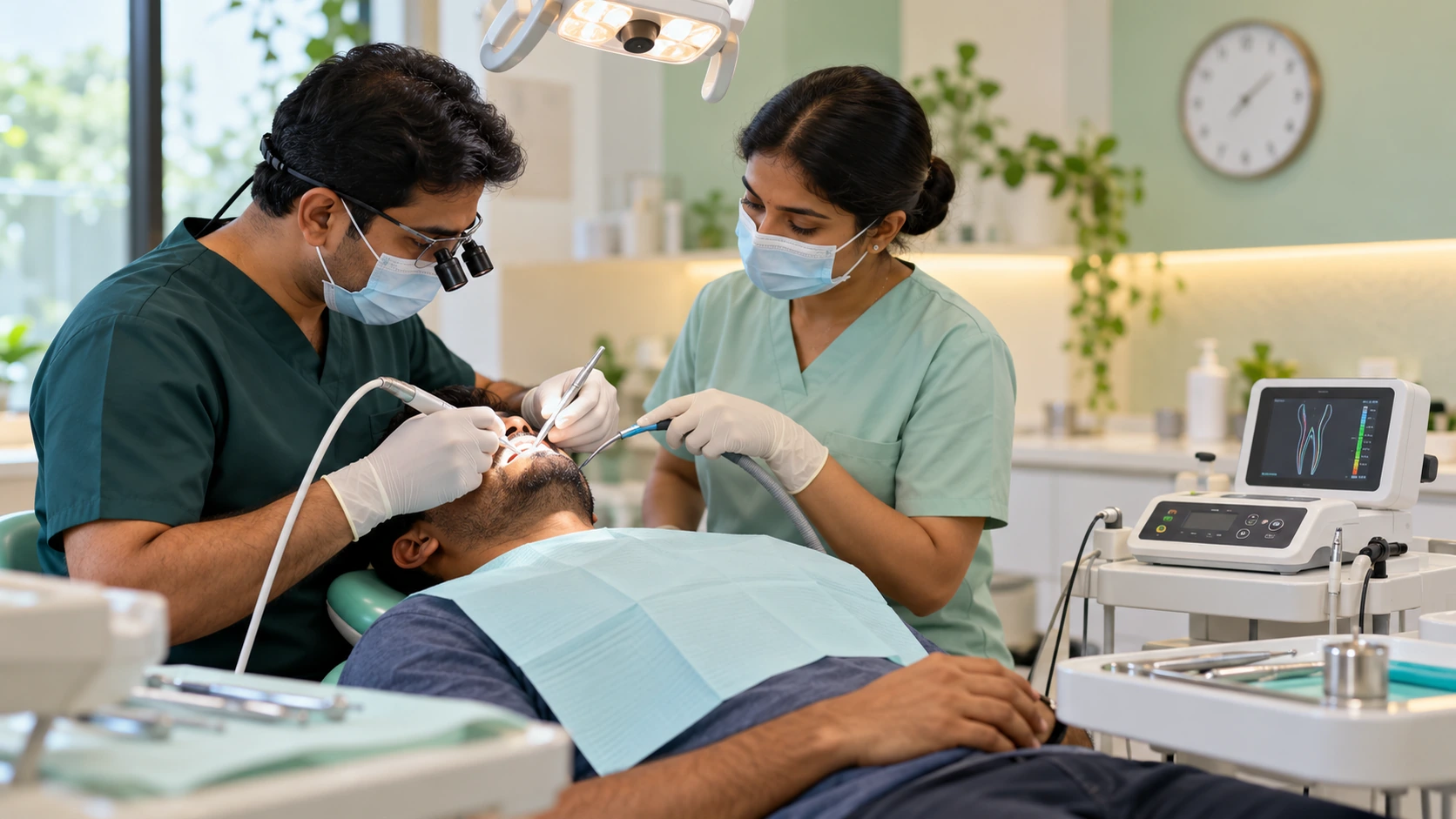
Single-Sitting Root Canal in Pondicherry: Complete Treatment Guide
A root canal treatment is designed to treat infection or inflammation inside a tooth while preserving the natural tooth whenever possible. Traditionally, some root canal treatments have required multiple appointments. However, selected cases can be completed in a single appointment.
Single-sitting root canal treatment involves cleaning, shaping, disinfecting, and sealing the root canal system during one treatment visit when the tooth and patient are suitable for this approach.
If you are searching for a single-sitting root canal in Pondicherry, it is important to understand that one-visit treatment is not appropriate for every tooth. The decision should be based on diagnosis, infection status, tooth anatomy, symptoms, and clinical findings.
What Is a Single-Sitting Root Canal?
A single-sitting root canal is a root canal treatment completed during one appointment when the case is clinically suitable.
The procedure generally involves:
- Examining the affected tooth
- Diagnosing the problem
- Accessing the root canal system
- Removing infected or inflamed pulp tissue
- Cleaning the canals
- Shaping the canals
- Disinfecting the canal system
- Filling and sealing the canals
- Planning the final restoration
Smile and Glow Dental Care currently lists single-sitting root canal treatment as one of its dental services in Pondicherry. Its service description states that rotary endodontic instruments, digital imaging, apex locators, and microscopes may be used as part of its single-sitting RCT workflow. :chatgpt-content-reference{index="1"}
Can Every Root Canal Be Completed in One Sitting?
No.
Single-sitting root canal treatment is suitable only for selected cases.
The dentist or Endodontist may consider:
- Condition of the dental pulp
- Presence of infection
- Severity of inflammation
- Root canal anatomy
- Number of canals
- Tooth location
- Existing restoration
- Previous root canal treatment
- Presence of swelling or drainage
- Overall clinical findings
Some complex infections or anatomically difficult teeth may require treatment over multiple visits.
Who May Be Suitable for Single-Sitting Root Canal Treatment?
A patient may be considered for single-sitting treatment when:
- The tooth can be adequately accessed
- The root canal anatomy is manageable
- The canals can be properly cleaned and shaped
- The infection can be appropriately controlled
- The tooth can be adequately sealed
- There are no clinical reasons requiring staged treatment
The final decision should be made after a dental examination.
Who May Need Multiple Root Canal Visits?
A conventional multi-visit approach may be considered when:
- There is significant infection
- The tooth has complex anatomy
- There is persistent drainage
- The tooth has previously received root canal treatment
- A broken instrument requires management
- The canals are heavily calcified
- Additional treatment is required
- The dentist needs to monitor healing or infection control
A longer treatment schedule does not necessarily mean that treatment is less effective. The appropriate number of appointments depends on the clinical condition.
Why Is Root Canal Treatment Needed?
Root canal treatment may be required when the pulp inside a tooth becomes inflamed or infected.
Common causes include:
- Deep tooth decay
- Large cavities
- Dental trauma
- Cracks
- Repeated dental procedures
- Tooth fracture
- Bacterial infection
Possible symptoms include:
- Persistent toothache
- Pain while biting
- Prolonged sensitivity to hot or cold
- Swelling
- Gum tenderness
- Tooth discoloration
- Pain that affects sleep
A tooth can sometimes have significant pulp damage without severe pain, so diagnosis should not be based on symptoms alone.
Single-Sitting Root Canal Treatment Process
The treatment generally follows several stages.
Step 1: Dental Examination
The dentist examines the tooth and discusses your symptoms and dental history.
Step 2: Diagnostic Imaging
Dental X-rays or other appropriate imaging may be used to evaluate:
- Root shape
- Canal anatomy
- Bone around the tooth
- Possible infection
- Previous treatment
Step 3: Local Anaesthesia
Local anaesthesia is used to numb the treatment area.
Step 4: Tooth Isolation
The tooth is isolated to maintain a clean treatment field.
Step 5: Access Opening
The dentist creates an access opening to reach the internal root canal system.
Step 6: Pulp Removal
The affected pulp tissue is removed.
Step 7: Canal Cleaning and Shaping
The root canals are cleaned and shaped using appropriate endodontic instruments.
Step 8: Canal Disinfection
The canals are disinfected to reduce microorganisms and debris.
Step 9: Root Canal Filling
The cleaned canals are filled and sealed using appropriate root canal filling materials.
Step 10: Final Restoration
The tooth is restored with an appropriate filling, onlay, crown, or other restoration depending on its condition.
The final restoration is important because a root canal-treated tooth still needs protection from future damage.
Technology Used for Single-Sitting Root Canal Treatment
Modern endodontic treatment can involve several technologies.
Depending on the case, these may include:
- Digital dental X-rays
- Electronic apex locators
- Rotary endodontic instruments
- Dental operating microscopes
- Magnification
- Irrigation systems
- Digital treatment records
Smile and Glow Dental Care states that its single-sitting root canal service uses rotary endodontic tools, digital imaging, apex locators, and microscopes. :chatgpt-content-reference{index="2"}
Technology supports treatment, but the diagnosis and clinical expertise of the dentist remain essential.
Digital Imaging in Single-Sitting Root Canal Treatment
Digital dental imaging can help the dentist evaluate the tooth before and during treatment.
It may provide information about:
- Root shape
- Canal anatomy
- Bone surrounding the tooth
- Existing infection
- Previous dental treatment
Digital imaging should be selected according to clinical need.
Apex Locator in Root Canal Treatment
An electronic apex locator is a device used to help determine the working length of a root canal.
Accurate working-length information is important when cleaning and shaping the canals.
An apex locator may be used alongside radiographs and other clinical information rather than as a standalone diagnostic tool.
Rotary Root Canal Treatment
Rotary endodontic instruments use motor-driven files to clean and shape root canals.
Potential benefits of rotary instrumentation include:
- Efficient canal preparation
- Consistent shaping
- Reduced manual instrumentation
- Support for complex canal preparation
The exact instrumentation system depends on the dentist and treatment requirements.
Microscope-Assisted Single-Sitting Root Canal
Dental microscopes provide enhanced magnification and illumination.
They can be useful for selected endodontic cases where the dentist needs improved visualization of:
- Small canal openings
- Fine anatomical details
- Calcified canals
- Existing root canal materials
- Cracks
- Complex internal structures
Smile and Glow Dental Care also provides microscope dentistry as part of its advanced dental services. :chatgpt-content-reference{index="3"}
Benefits of Single-Sitting Root Canal Treatment
When clinically appropriate, single-sitting treatment may offer practical advantages.
One Main Treatment Appointment
The cleaning, shaping, and sealing stages can be completed during one visit.
Fewer Appointments
Patients may not need to return for multiple root canal sessions.
Convenient for Busy Patients
One-visit treatment can be useful for people with demanding work, travel, or academic schedules.
Faster Completion of the Endodontic Stage
The main root canal procedure can be completed in one appointment when the case is suitable.
Reduced Appointment-Related Anxiety
Some patients prefer fewer treatment visits.
However, these benefits apply only when single-sitting treatment is clinically appropriate.
Is Single-Sitting Root Canal Better Than Multiple-Visit Root Canal?
There is no universal answer.
The appropriate treatment schedule depends on the condition of the tooth.
A single-sitting approach can be suitable for selected cases, while a multi-visit approach may be more appropriate for other teeth.
The goal should be adequate diagnosis, cleaning, disinfection, sealing, restoration, and long-term preservation of the tooth rather than simply reducing the number of appointments.
Is Single-Sitting Root Canal Safe?
When appropriately selected and performed by a trained dental professional, single-sitting root canal treatment can be a treatment option for suitable cases.
However, not every infection or tooth anatomy is appropriate for one-visit treatment.
The dentist should determine whether the tooth can be adequately cleaned, disinfected, shaped, and sealed during the planned appointment.
Is Single-Sitting Root Canal Painful?
The root canal procedure is generally performed under local anaesthesia.
You may experience:
- Pressure during treatment
- Mild jaw fatigue from keeping your mouth open
- Temporary tenderness after treatment
Some post-treatment sensitivity or discomfort can occur.
If you experience severe or worsening pain, swelling, fever, or other concerning symptoms after treatment, contact your dentist.
How Long Does a Single-Sitting Root Canal Take?
The duration varies according to the tooth and its anatomy.
Factors include:
- Tooth location
- Number of canals
- Canal complexity
- Infection
- Existing restoration
- Previous treatment
- Difficulty accessing the canals
A straightforward case may be completed within one extended appointment, while complex cases may take longer or require more than one visit.
Single-Sitting Root Canal for Front Teeth
Front teeth often have simpler root canal anatomy than some posterior teeth.
However, suitability still depends on:
- Root anatomy
- Infection
- Tooth condition
- Previous treatment
- Clinical findings
A dentist should evaluate the tooth before deciding whether one-visit treatment is appropriate.
Single-Sitting Root Canal for Back Teeth
Back teeth can have multiple canals and more complex anatomy.
Molars may require additional time for:
- Canal identification
- Cleaning
- Shaping
- Disinfection
- Filling
- Restoration
Some molars can still be treated in one sitting when the case is suitable.
Single-Sitting Root Canal for Infected Teeth
The presence and extent of infection are important when considering one-visit treatment.
A dentist may evaluate:
- Swelling
- Pain
- Drainage
- Bone changes
- Canal condition
- Pulp status
If staged treatment is more appropriate, the dentist may recommend multiple appointments.
Can a Root Canal Be Done in One Visit With an Abscess?
Not every tooth with an abscess is suitable for single-sitting treatment.
The dentist needs to assess:
- Source of infection
- Presence of swelling
- Drainage
- Tooth restorability
- Canal anatomy
- Overall clinical condition
In some cases, the treatment can be completed in one visit. In others, staged treatment may be more appropriate.
The decision should be made after examination rather than based solely on the presence of pain or swelling.
Single-Sitting Root Canal for Previously Treated Teeth
Previously treated teeth are generally more complex.
They may require:
- Removal of previous root canal material
- Identification of missed canals
- Management of calcification
- Instrument retrieval
- Treatment of persistent infection
- Evaluation for cracks
Such cases may require specialized endodontic treatment and cannot automatically be completed in one sitting.
What Happens After a Single-Sitting Root Canal?
After the root canal:
- The tooth may feel tender temporarily
- Avoid chewing hard foods on the tooth until advised
- Follow the dentist's instructions
- Complete the final restoration
- Attend recommended follow-up appointments
The tooth may require a crown depending on how much tooth structure remains and where the tooth is located.
Why Is a Crown Sometimes Needed After Root Canal Treatment?
A root canal removes infected or inflamed pulp and allows the tooth to be preserved.
However, the remaining tooth structure may be weakened or significantly damaged.
A crown may be recommended to:
- Protect the tooth
- Restore chewing function
- Reduce the risk of fracture
- Restore tooth shape
The need for a crown depends on the tooth's condition and restoration requirements.
Single-Sitting Root Canal and Dental Crowns
Root canal treatment and the final restoration are separate stages of care.
A tooth treated in one root canal appointment may still require:
- Temporary restoration
- Permanent filling
- Onlay
- Dental crown
- Other definitive restoration
The dentist will determine the appropriate restoration based on the remaining tooth structure.
How to Care for Your Tooth After Single-Sitting RCT
After treatment:
- Follow your dentist's instructions
- Avoid chewing hard foods until the restoration is completed
- Brush normally unless advised otherwise
- Clean between your teeth
- Attend the restoration appointment if required
- Avoid biting hard non-food objects
- Report persistent pain or swelling
Good oral hygiene helps protect both the treated tooth and the surrounding teeth.
What Are the Possible Complications?
As with other dental procedures, root canal treatment can have complications.
Possible issues include:
- Persistent infection
- Missed canal anatomy
- Instrument separation
- Tooth fracture
- Inadequate restoration
- Post-treatment discomfort
- Need for retreatment
Complex anatomy can increase treatment difficulty.
Your dentist should discuss procedure-specific risks before treatment.
Can a Single-Sitting Root Canal Fail?
Root canal treatment can sometimes require further treatment.
Possible reasons include:
- Complex canal anatomy
- Missed canals
- Persistent infection
- Leakage
- Tooth fracture
- Inadequate cleaning
- Inadequate restoration
If symptoms return, the dentist may evaluate the tooth for retreatment or another appropriate treatment option.
Single-Sitting Root Canal vs Multiple-Visit Root Canal
| Feature | Single-Sitting RCT | Multiple-Visit RCT |
|---|---|---|
| Main treatment visits | One, when suitable | Two or more when required |
| Cleaning and shaping | Completed in planned single visit | May be divided across appointments |
| Suitable for | Selected cases | Complex or staged cases |
| Appointment convenience | Fewer visits | More visits |
| Infection management | Depends on clinical condition | Allows staged treatment when necessary |
| Final restoration | May require separate restoration appointment | May also require separate restoration |
The number of appointments should be determined by the clinical condition of the tooth.
How Much Does Single-Sitting Root Canal Cost in Pondicherry?
There is no universal cost for single-sitting root canal treatment.
The total cost may depend on:
- Tooth location
- Number of canals
- Treatment complexity
- Diagnostic imaging
- Endodontic technology
- Previous treatment
- Restoration required
- Dental crown
- Laboratory charges
A consultation is necessary to determine the appropriate treatment and provide an accurate estimate.
Does Single-Sitting RCT Cost Less?
A one-visit treatment may reduce the number of appointments, but the total treatment cost depends on the actual procedure and restoration required.
The cost may include:
- Consultation
- Diagnostic imaging
- Root canal treatment
- Additional endodontic procedures
- Temporary restoration
- Permanent restoration
- Crown if required
Therefore, appointment count alone should not be used to estimate the total cost.
Why Choose an Endodontist for Single-Sitting Root Canal?
Endodontists specialize in diagnosing and treating conditions involving the dental pulp and root canal system.
Specialist evaluation may be particularly useful when a tooth has:
- Complex anatomy
- Difficult root canals
- Previous root canal treatment
- Persistent symptoms
- Calcified canals
- Complicated infection
Smile and Glow Dental Care is led by Dr. Prasanna Kumar, an Endodontist, and provides endodontic and microscope-assisted dental services in Pondicherry. :chatgpt-content-reference{index="4"}
Why Choose Smile and Glow Dental Care for Single-Sitting Root Canal?
entity["turn0business0","SmileKraft Dental Clinic (Smile & glow)"] provides single-sitting root canal treatment in Puducherry.
Its published service information describes the use of:
- Rotary endodontic tools
- Digital imaging
- Apex locators
- Dental microscopes
- Endodontic treatment planning
The clinic states that single-sitting treatment is offered when the case is suitable. :chatgpt-content-reference{index="6"}
The clinic's website also identifies Dr. Prasanna Kumar as an Endodontist and lists root canal treatment, single-sitting root canal treatment, digital dentistry, microscope dentistry, and digitally designed crowns among its services. :chatgpt-content-reference{index="7"}
Single-Sitting Root Canal Consultation in Pondicherry
If you have persistent tooth pain, sensitivity, swelling, or pain while chewing, the first step should be a dental examination.
During the consultation, the dentist may assess:
- Tooth condition
- Pulp status
- Root anatomy
- Infection
- Existing restorations
- Bone around the tooth
- Tooth restorability
The dentist can then determine whether:
- Single-sitting root canal treatment
- Multi-visit root canal treatment
- Root canal retreatment
- Extraction
- Another treatment
is appropriate.
Final Thoughts: Single-Sitting Root Canal in Pondicherry
Single-sitting root canal treatment can provide a convenient one-visit approach for selected cases.
It may involve:
- Diagnosis
- Digital imaging
- Local anaesthesia
- Pulp removal
- Canal cleaning
- Canal shaping
- Disinfection
- Root canal filling
- Sealing
- Restoration planning
However, completing a root canal in one appointment should not be the only treatment goal.
The priority is to properly diagnose the tooth, clean and disinfect the root canal system, seal it appropriately, and restore the tooth so that it can function when clinically possible.
If you are looking for a single-sitting root canal in Pondicherry, schedule a dental consultation to determine whether your tooth is suitable for one-visit treatment.
Frequently Asked Questions
What is a single-sitting root canal?
A single-sitting root canal is a root canal treatment completed in one appointment when the tooth and patient are clinically suitable for one-visit treatment.
Can every root canal be completed in one sitting?
No. Complex infections, difficult anatomy, previous root canal treatment, persistent drainage, and other clinical factors may require multiple visits.
Is single-sitting root canal treatment painful?
The procedure is generally performed under local anaesthesia. Some temporary tenderness can occur after treatment.
How long does a single-sitting root canal take?
Treatment time varies according to the tooth, number of canals, anatomy, infection, and complexity. A suitable case may require one extended appointment.
Can an infected tooth receive a single-sitting root canal?
Some infected teeth can be treated in one visit, but not every infected tooth is suitable. The dentist must assess the infection and tooth condition first.
Can a molar receive a single-sitting root canal?
Yes, some molars can be treated in one appointment. However, molars often have more complex canal anatomy, so the dentist must determine suitability.
What technology is used for single-sitting root canal treatment?
Depending on the case, treatment may use digital X-rays, apex locators, rotary endodontic instruments, and dental microscopes.
Is a crown required after a single-sitting root canal?
A crown may be recommended depending on the amount of remaining tooth structure, tooth location, and risk of fracture. Not every root canal-treated tooth requires the same type of restoration.
What should I avoid after a single-sitting root canal?
Avoid chewing hard foods on the treated tooth until the dentist confirms that it is adequately restored. Follow all post-treatment instructions.
How much does single-sitting root canal treatment cost in Pondicherry?
The cost varies according to the tooth, complexity, technology, diagnostic procedures, and final restoration required. A dental consultation is needed for an accurate estimate.
Can a previously root canal-treated tooth be treated in one sitting?
Retreatment cases are often more complex and may require additional procedures. The dentist or Endodontist must assess the tooth before deciding on the treatment schedule.
Where can I get single-sitting root canal treatment in Pondicherry?
SmileKraft Dental Clinic (Smile & glow) provides single-sitting root canal treatment in Puducherry for suitable cases, alongside conventional root canal treatment and advanced endodontic services. :chatgpt-content-reference{index="8"}