


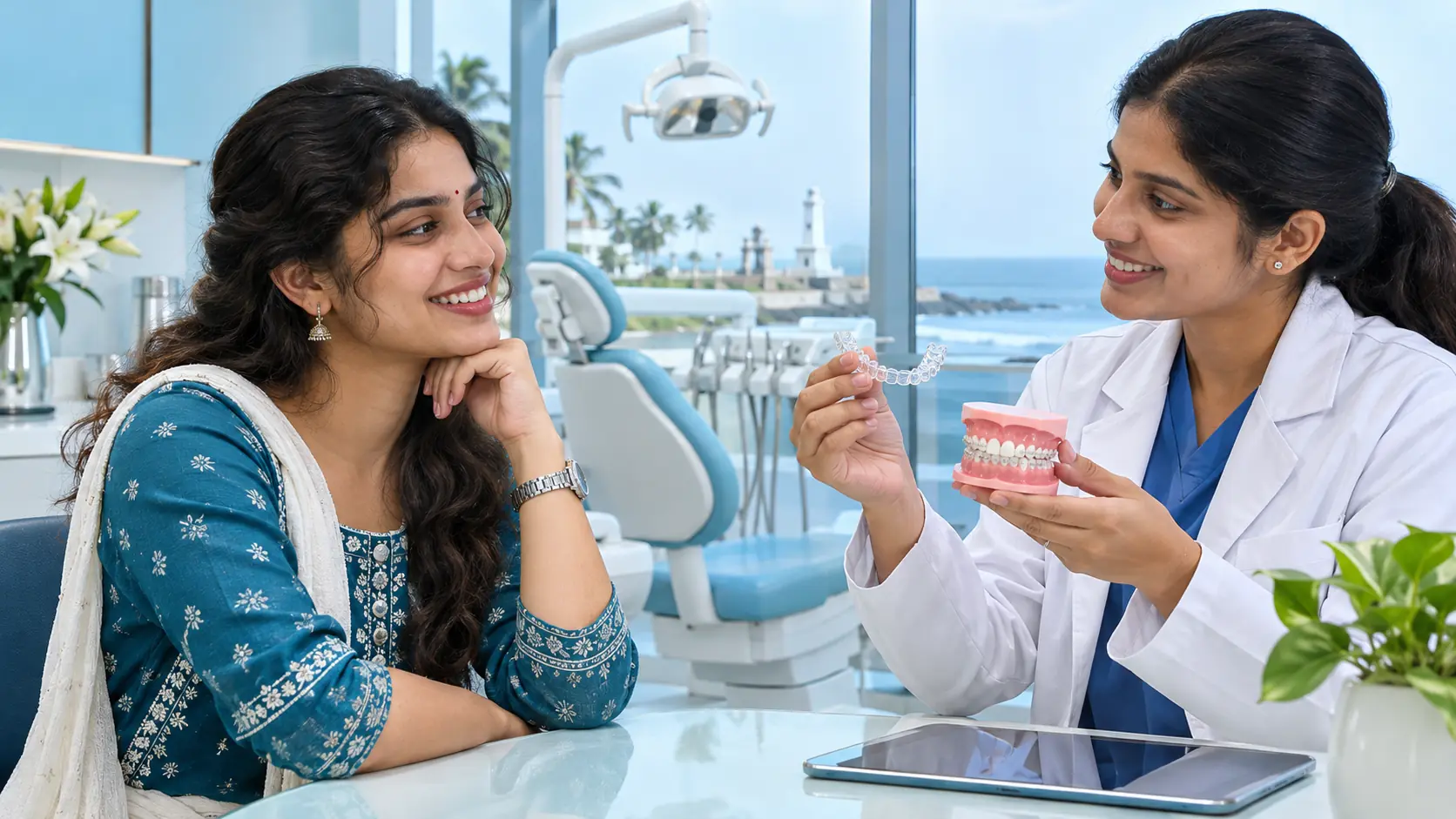
Uneven Teeth Treatment in Pondicherry
Uneven, crooked, crowded or widely spaced teeth can affect the appearance of a smile, but alignment is not only a cosmetic concern. Tooth position can also influence biting, chewing, speech, oral hygiene and the way the upper and lower teeth meet.
Uneven teeth treatment in Pondicherry may involve metal braces, ceramic braces, clear aligners or other dental procedures depending on the cause and complexity. Some minor shape differences may be improved with cosmetic dentistry, while significant alignment or bite problems generally require orthodontic treatment.
At Smile & Glow Dental Care, treatment planning begins with an examination of the teeth, gums, bite and jaw relationship. This helps identify an option that is appropriate for the patient’s oral health, lifestyle and treatment goals.
Quick Answer: What Is the Best Treatment for Uneven Teeth?
The most suitable treatment depends on whether the concern involves tooth position, tooth shape, spacing, crowding or jaw alignment.
Common treatment options include:
- Fixed metal braces
- Tooth-coloured ceramic braces
- Dentist-supervised clear aligners
- Functional or removable orthodontic appliances for selected growing children
- Space creation or expansion when clinically suitable
- Tooth extraction in selected crowded cases
- Dental bonding for minor shape differences
- Veneers or crowns for carefully selected cosmetic concerns
- Corrective jaw surgery for significant skeletal problems
- Retainers after active orthodontic treatment
A clinical examination, dental X-rays and orthodontic records may be needed before the dentist can recommend the correct option.
What Are Uneven Teeth?
Uneven teeth is a general description that may include:
- Crooked or rotated teeth
- Crowded teeth
- Gaps between teeth
- Protruding front teeth
- Teeth positioned higher or lower than neighbouring teeth
- Overbite
- Underbite
- Crossbite
- Open bite
- Upper and lower dental midlines that do not match
- Teeth that do not meet correctly during biting
The clinical term for an incorrect bite is malocclusion. Some people have relatively straight teeth but still have a bite problem because the upper and lower jaws do not meet correctly.
What Causes Crooked or Uneven Teeth?
Teeth may become uneven because of inherited jaw and tooth-size patterns, childhood habits, early tooth loss or changes occurring later in life.
Possible causes include:
- Insufficient space in the jaw
- Large teeth in a relatively small dental arch
- Missing or extra teeth
- Early loss of baby teeth
- Delayed eruption of permanent teeth
- Thumb or finger sucking
- Prolonged pacifier use
- Tongue-thrusting habits
- Mouth breathing associated with an airway concern
- Dental trauma
- Gum disease and loss of tooth support
- Teeth shifting into an untreated missing-tooth space
- Natural tooth movement with age
- Not wearing retainers after previous orthodontic treatment
An examination is important because treatment should address the cause as well as the visible tooth position.
Why Should Uneven Teeth Be Evaluated?
Some uneven teeth cause no immediate health problem. However, significant crowding or bite irregularities may make brushing and cleaning between teeth more difficult.
Depending on the condition, untreated alignment problems may contribute to:
- Plaque accumulation in difficult-to-clean areas
- Tooth decay
- Gum inflammation
- Uneven tooth wear
- Chipping of teeth
- Difficulty biting or chewing
- Accidental biting of the cheeks or tongue
- Speech difficulties in selected cases
- Increased risk of trauma to protruding front teeth
- Jaw discomfort in some patients
- Reduced confidence while smiling
Straightening teeth does not guarantee the prevention of every dental problem. Good oral hygiene, regular dental examinations and healthy habits remain necessary during and after treatment.
How Are Uneven Teeth Diagnosed?
The dentist or orthodontist will assess more than the appearance of the front teeth. A complete orthodontic evaluation may include:
- Dental and medical history
- Examination of teeth and gums
- Assessment of crowding and spacing
- Evaluation of the bite
- Jaw and facial proportions
- Tooth eruption and missing teeth
- Jaw-joint symptoms
- Existing fillings, crowns, bridges or implants
- Clinical photographs
- Digital scans or dental impressions
- Dental and orthodontic X-rays when required
These records help determine which teeth need to move, whether sufficient space is available and how the proposed treatment may affect the bite.
Active tooth decay and gum disease generally need to be managed before orthodontic treatment begins.
Treatment Options for Uneven Teeth
The right option depends on the patient’s age, dental health, treatment goals, bite and complexity of tooth movement.
Fixed Metal Braces
Metal braces use brackets attached to the teeth and an orthodontic wire to apply controlled pressure. The wire and any supporting components are adjusted as treatment progresses.
Metal braces can treat a wide range of alignment and bite problems, including:
- Moderate or severe crowding
- Rotated teeth
- Significant spacing
- Protruding teeth
- Overbite and underbite
- Crossbite
- Complex tooth movements
Because braces remain attached throughout active treatment, they do not depend on the patient remembering to insert them each day. However, careful cleaning and dietary changes are required.
Ceramic Braces
Ceramic braces work similarly to metal braces but use tooth-coloured or translucent brackets, making them less noticeable.
They may be considered by patients who want a fixed treatment with a more discreet appearance. Ceramic brackets can be more fragile than metal brackets and may not suit every bite or orthodontic problem.
The dentist or orthodontist will consider the patient’s tooth position, bite forces and ability to maintain oral hygiene before recommending ceramic braces.
Clear Aligners
Clear aligners are custom-made removable trays that gradually move selected teeth. The patient progresses through a planned series of aligners under professional supervision.
Potential benefits include:
- Less noticeable appearance
- Removal during meals
- Easier brushing and flossing
- Fewer restrictions on food
- Digital treatment planning
Clear aligners require consistent daily wear. They may help treat mild to moderate crowding, spacing and selected bite problems, but complex movements may be treated more predictably with fixed braces or a combined approach.
Patients should not begin aligner treatment without a proper dental examination, X-rays when required and ongoing professional monitoring. Unsupervised tooth movement may cause an uneven bite, gum problems, root damage or unintended tooth movement.
Orthodontic Treatment for Children
Children may benefit from an orthodontic assessment when there is:
- Early or late loss of baby teeth
- Delayed eruption of permanent teeth
- Severe crowding
- Protruding front teeth
- Crossbite
- Underbite
- Difficulty biting or chewing
- Persistent thumb-sucking or tongue habits
- Jaw-growth imbalance
- Teeth erupting in an unusual position
Not every child needs immediate braces. In some cases, the dentist may monitor dental development until the appropriate stage. Selected children may benefit from early treatment using expansion, habit correction or growth-guidance appliances.
Parents should avoid starting appliance treatment based only on age. Timing should be determined by dental development and the nature of the problem.
Creating Space for Crowded Teeth
When there is insufficient room to align the teeth, the treatment plan may include:
- Controlled expansion in suitable cases
- Minor reduction between selected teeth
- Movement of back teeth
- Use of orthodontic anchorage
- Extraction of selected teeth when clinically necessary
The decision depends on the degree of crowding, facial profile, gum condition, bone support, tooth size and bite.
Promises of extraction-free treatment should not be made before a complete assessment. Some patients can be treated without removal of teeth, while others may achieve a healthier and more stable result with carefully planned extractions.
Dental Bonding
Dental bonding uses tooth-coloured resin to modify the shape of a tooth. It may help improve:
- A minor edge irregularity
- Small gaps
- Slight differences in tooth length
- Chipped teeth
- Small or unusually shaped teeth
Bonding changes tooth shape but does not move the tooth or correct a significant bite problem. It may be used after orthodontic treatment to refine the final appearance.
Veneers and Dental Crowns
Veneers or crowns may improve the appearance of selected teeth when the concern involves tooth shape, size, colour, wear or damage.
They are not a substitute for orthodontics when teeth are significantly crowded or the bite is incorrect. Preparing otherwise healthy teeth for cosmetic restorations may require irreversible removal of tooth structure.
A conservative assessment should compare orthodontic movement, bonding and restorative treatment before veneers or crowns are selected.
Corrective Jaw Surgery
When uneven teeth are associated with a significant difference in jaw size or position, orthodontic treatment alone may not fully correct the bite.
Corrective jaw surgery may be considered after assessment by an orthodontist and oral and maxillofacial surgeon. Treatment usually involves detailed planning and orthodontics before and after surgery.
Jaw surgery is reserved for selected skeletal conditions and is not required for routine crooked or crowded teeth.
Braces or Clear Aligners: Which Is Better?
Neither option is universally better. The decision depends on the required movements, patient preferences and ability to follow instructions.
Braces May Be Preferred When:
- Crowding is severe
- Teeth require complex rotation or vertical movement
- The bite needs significant correction
- Teeth must be moved after extraction
- Wearing removable trays consistently may be difficult
- More controlled orthodontic mechanics are required
Clear Aligners May Be Preferred When:
- The problem is suitable for aligner treatment
- A less visible option is important
- The patient can follow the prescribed wear schedule
- The patient wants to remove the appliance during meals
- Easier brushing and flossing is a priority
Attachments, elastics or other orthodontic aids may still be required with clear aligners. Only an individual assessment can determine which option is likely to provide a predictable result.
Can Adults Straighten Uneven Teeth?
Yes. Healthy teeth can be moved orthodontically at many ages. Adults may choose braces or clear aligners to correct long-standing crowding, gaps, relapse after previous treatment or bite problems.
Adult treatment planning may need to consider:
- Gum recession or periodontal disease
- Missing teeth
- Dental implants
- Existing crowns, bridges or veneers
- Reduced bone support
- Worn or heavily restored teeth
- Jaw-joint symptoms
- Previous orthodontic treatment
Dental implants cannot be moved orthodontically like natural teeth. Their position must be considered carefully when planning treatment.
How Long Does Uneven-Teeth Treatment Take?
Treatment time varies according to the complexity of the problem and the type of appliance. Minor alignment may take several months, while comprehensive bite correction may take considerably longer.
Factors affecting duration include:
- Amount of crowding or spacing
- Complexity of the bite
- Number and type of tooth movements
- Patient age and biological response
- Missed appointments
- Broken braces
- Aligner wear compliance
- Need for extractions or additional procedures
- Oral hygiene and gum health
A personalised estimate can be provided after diagnostic records and treatment planning. Very fast front-tooth alignment may not correct the entire bite or provide the most stable long-term result.
Does Orthodontic Treatment Hurt?
Patients may experience pressure or tenderness for a few days after braces are fitted, adjusted or after changing to a new aligner.
Temporary discomfort is usually manageable with soft foods and pain relief recommended by the treating professional. Sharp wires, broken appliances or persistent pain should be reported.
Severe pain, significant swelling, trauma or a tooth that becomes unusually mobile requires prompt dental assessment.
Caring for Teeth During Braces Treatment
Fixed braces can trap food and plaque, making cleaning especially important.
Patients should:
- Brush carefully with fluoride toothpaste
- Clean around brackets and beneath wires
- Use an interdental brush or flossing aid as demonstrated
- Limit frequent sugary food and drinks
- Avoid hard, sticky foods that may damage braces
- Attend orthodontic adjustment visits
- Continue routine dental check-ups
- Report loose brackets or broken wires
- Wear elastics exactly as instructed
Poor cleaning during braces treatment can cause tooth decay, gum inflammation or permanent white marks on the enamel.
Caring for Clear Aligners
For safe aligner use:
- Wear aligners for the prescribed number of hours
- Remove them before eating unless specifically instructed otherwise
- Brush teeth before replacing the trays
- Clean aligners using the recommended method
- Do not use very hot water, which may distort them
- Store aligners safely when not in use
- Do not skip aligners or advance early without approval
- Attend monitoring appointments
- Report unexpected pain or bite changes
Drinking sugary or acidic beverages while wearing aligners can trap liquid against the teeth and increase the risk of enamel damage.
Why Are Retainers Necessary?
Teeth can move back toward their previous positions after braces or aligner treatment. This is called orthodontic relapse.
Retainers help stabilise the teeth after active movement. They may be:
- Removable clear retainers
- Hawley-style removable retainers
- Fixed wires attached behind selected teeth
- A combination of fixed and removable retention
Patients should follow the prescribed retainer schedule. Stopping retainer use may allow crowding or spacing to return, even years after treatment.
Fixed retainers also require regular cleaning and monitoring. A loose or broken retainer should be assessed before significant tooth movement occurs.
How Much Does Uneven-Teeth Treatment Cost in Pondicherry?
The cost depends on the type and complexity of treatment rather than the appearance of one tooth alone.
Factors that may affect the fee include:
- Diagnostic records and X-rays
- Metal, ceramic or aligner treatment
- Severity of crowding or bite correction
- Estimated treatment duration
- Need for extractions or additional appliances
- Restorative treatment before or after orthodontics
- Retainers
- Follow-up requirements
A written treatment plan and cost estimate can be provided after examination. Patients should clarify whether the quoted fee includes records, adjustments, replacement appliances and retainers.
When Should You Consult a Dentist?
Arrange an assessment if you have:
- Visibly crooked or crowded teeth
- Gaps that concern you
- Difficulty cleaning between teeth
- Teeth that do not meet correctly
- Difficulty biting or chewing
- Protruding front teeth
- Uneven tooth wear
- Teeth that shifted after previous braces
- A lost or broken retainer
- Concerns about a child’s tooth eruption
- Interest in braces or clear aligners
Early assessment can identify whether immediate treatment is necessary or whether monitoring is more appropriate.
Uneven Teeth Treatment at Smile & Glow Dental Care
Smile & Glow Dental Care provides evaluation and treatment planning for crooked, crowded, spaced and uneven teeth in Pondicherry.
Depending on the diagnosis, care may include:
- Complete dental and bite assessment
- Digital scans or impressions
- Orthodontic X-rays when required
- Fixed-braces evaluation
- Clear-aligner assessment
- Oral-hygiene preparation
- Monitoring throughout treatment
- Retainer planning
- Cosmetic refinement after alignment when appropriate
The objective is not simply to make the front teeth appear straight. Treatment planning also considers gum health, tooth roots, bite function, facial balance and long-term stability.
Frequently Asked Questions
Can Uneven Teeth Be Corrected Without Braces?
Minor shape differences may sometimes be improved with bonding or carefully selected veneers. Clear aligners can move teeth without fixed braces in suitable cases. Significant crowding or bite problems generally require orthodontic treatment.
Are Clear Aligners Suitable for Every Patient?
No. Clear aligners can treat many mild to moderate alignment problems, but severe crowding, complex tooth movements and major bite problems may require braces or combined treatment.
Is Tooth Extraction Always Necessary for Crowded Teeth?
No. Some crowded teeth can be treated through expansion, controlled movement or minor space creation. Other patients may require extraction to achieve a stable bite and balanced result. The decision must follow a detailed assessment.
Can Adults Get Braces?
Yes. Adults with healthy teeth and suitable gum and bone support can receive orthodontic treatment. Existing restorations, missing teeth and periodontal health must be considered during planning.
How Long Will I Need to Wear Braces or Aligners?
Treatment may range from several months for selected minor concerns to considerably longer for comprehensive alignment and bite correction. An individual estimate is provided after examination and diagnostic records.
Will My Teeth Stay Straight After Treatment?
Teeth can shift after treatment. Wearing retainers according to professional instructions is essential for maintaining the result and reducing orthodontic relapse.
Is Online or Home Aligner Treatment Safe?
Tooth movement should be planned and monitored by a qualified dentist or orthodontist. An in-person examination helps detect decay, gum disease, bone problems and bite risks that may not be visible through photographs or impressions alone.
What Happens If I Stop Wearing My Retainer?
The teeth may gradually move toward their previous positions. If a retainer no longer fits, do not force it into place; arrange a dental or orthodontic assessment.
Book an Uneven-Teeth Consultation in Pondicherry
If you are considering braces, clear aligners or another treatment for uneven teeth, schedule an assessment at Smile & Glow Dental Care in Pondicherry.
A personalised consultation can explain the cause of the alignment problem, suitable treatment options, expected duration, costs, limitations and retainer requirements.
This article provides general educational information and does not replace a clinical examination, diagnosis or personalised advice from a qualified dentist or orthodontist.